















 The 10 most alternative cities in South America
Discover South America's top 10 alternative cities! From Valparaíso's vibrant streets to La Paz's high-altitude charm and Medellín's innovative spirit.
Average temperatures, rainfall, sunshine and the best time to visit Caxias do Sul.
 –
10-day forecastForecast
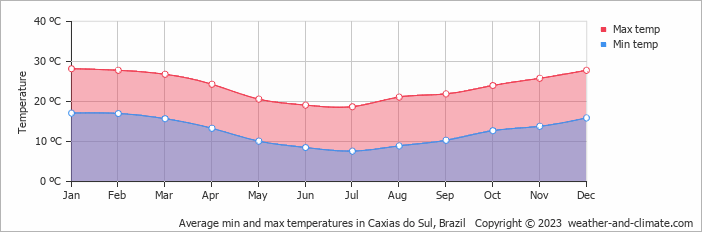
Temperatures in Caxias do Sul, Rio Grande do Sul, Brazil, shift moderately through the seasons. The warmest month is January at 28°C (82°F), and the coolest is July at 19°C (66°F).
With around 2064 mm (81 in) of annual rainfall, Caxias do Sul has a notably wet climate. However, this rainfall is not evenly distributed, the city has a distinct rainy season from December to February. The wettest month is October.
Pick a month to see the average temperature, rainfall and sunshine in Caxias do Sul - and find the best time to visit.
The climate in Caxias do Sul experiences moderate temperature changes, with mild shifts between seasons. Average daytime temperatures reach a comfortable 28°C (82°F) in January. In July, the coolest month of the year, temperatures drop to a pleasant 19°C (66°F).
At night, temperatures range from around 17°C (63°F) in January to 8°C (46°F) in July.
Check out our detailed temperature page for more information.
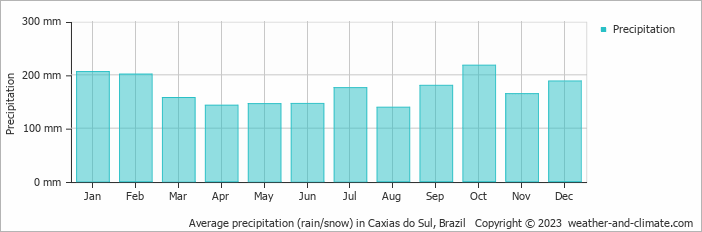
Caxias do Sul has a notably wet climate with abundant precipitation, recording 2064 mm (81 in) of rainfall per year. Despite minor fluctuations, Caxias do Sul enjoys fairly consistent precipitation throughout the year. In October, you can expect around 218 mm (8.6 in) of precipitation, while in August, Caxias do Sul receives about 139 mm (5.5 in). For more details, please visit our Caxias do Sul Precipitation page.
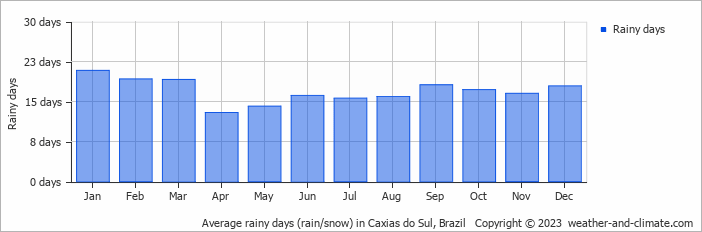
Monthly ratings reflect general weather comfort, based on daytime temperature and rainfall. Swimming and winter conditions are highlighted separately where relevant.
March, April, May, August, September and November typically offer the most optimal weather in Caxias do Sul. In contrast, January, February and October tend to have less optimal conditions. Caxias do Sul has a distinct rainy season from December to February.
Daytime highs range from 19°C (66°F) in July to 28°C (82°F) in January. Nighttime lows range from 8°C (46°F) to 17°C (63°F).
Annual rainfall is around 2064 mm (81 in). October is the wettest month with 218 mm (8.6 in), while August is the driest with 139 mm (5.5 in).
Caxias do Sul is highlighted - select any city to see its climate.
Where to go in November - average daytime high across popular destinations.
Need travel inspiration? Check out our bucket list articles and be inspired.
The 10 most alternative cities in South America
Discover South America's top 10 alternative cities! From Valparaíso's vibrant streets to La Paz's high-altitude charm and Medellín's innovative spirit.

 The 5 most tranquil retreats in the Amazon Rainforest, Brazil
Discover top sustainable lodges in the Amazon. Enjoy unique wildlife, eco-friendly stays, and immersive experiences at Anavilhanas, Cristalino, and more.
 Brazil in November: Where Is the Best Weather?
Discover where Brazil has the best weather in November, comparing Fortaleza, Salvador, Rio, São Paulo, Florianópolis, Brasília and Foz do Iguaçu.
 An alternative way to discover Rio de Janeiro
Don't feel like seeing the traditional tourist sights in Rio de Janeiro? We have made an overview of the sights in Rio de Janeiro that you must see if you want to visit Rio in an alternative way.