Vinstra Monthly Rainfall & Precipitation
This page shows both the average monthly rainfall and the number of rainy days in Vinstra, Oppland, Norway. These averages rely on historical data collected over 30 years, from 1990 to 2020. Let's now guide you through the details for a complete overview.
Generally, Vinstra receives mid-range precipitation levels, with 873 mm (34 in) annually.
Monthly Rainfall & Rainy Days
Monthly Precipitation Levels

The average number of days each month with precipitation (> 0.2 mm (0.01 in))
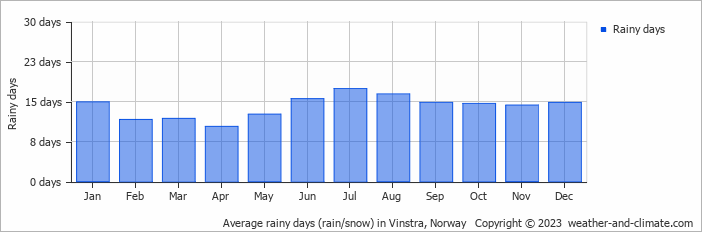
The climate in Vinstra shows significant variation throughout the year. Expect 114 mm (4.5 in) of precipitation during the wettest month July, distributed over 17 rainy days.
In contrast, February offers drier and sunnier days, with around 43 mm (1.7 in) of snowfall over 12 snowy days.
July, the wettest month, has a maximum daytime temperature of 18°C (64°F). The city receives 238 hours of sunshine in this period. During the driest month February you can expect a temperature of -4°C (25°F). For more detailed insights into the city's temperatures, visit our Vinstra Temperature page.
Annual Rainfall in Norway: City Comparison
The map below shows the annual precipitation across Norway. You can also select the different months in case you are interested in a specific month.
Vinstra vs World: Rainfall Compared
Vinstra's average annual precipitation is 873 mm (34 in). Let's compare this to some popular worldwide tourist destinations:
Chicago, USA, sees an annual precipitation of 1062 mm (42 in), with rain and snow contributing to its humid climate.
Meanwhile, Buenos Aires, Argentina, enjoys a humid subtropical climate with 1000 mm (39 in) of annual rainfall, mostly in the summer.
In Tokyo, Japan, the average annual precipitation is 1528 mm (60 in), with significant summer rains due to typhoon season.
Singapore, situated near the equator, gets 2581 mm (102 in) of rainfall annually, with no distinct dry season and consistent monthly precipitation.
Precipitation amounts are measured using specific gauges installed at weather stations, collecting both rain and snow and any other type of precipitation. Rainfall is measured directly in millimeters, while that from snow and ice is obtained by melting it. Automated systems often incorporate heaters to make this easier.
Information from these stations is transmitted via Wi-Fi, satellite, GPS, or telephone connections to central monitoring networks. This information is immediately updated and integrated into weather models and forecasts.
Precipitation has a very strong role in determining the local climate and ecosystem:
- Changing Rainfall Patterns: Global warming causes drastic changes in the patterns of rainfall. Some areas have been experiencing increased frequency and intensity of rainfall, while other areas experience longer dry spells or even droughts.
- Local Impacts: Many regions are experiencing heavier rainfall in the winter months and drier, hotter summers. This affects agriculture, water resources, and ecosystems.
- "Ginger" was the longest-lasting Atlantic tropical storm, which spun around the open ocean for 28 days in 1971.
- The world's largest snowflake was recorded in the Guinness Book of Records, at 38 cm (15 inches) wide and 20 cm (7.9 inches) thick. The snowflake fell at Fort Keogh, Montana, USA, on 28 January 1887.
- The greatest snowfall recorded was on Mt. Rainier, Washington State, USA, over 31.5 meters (103 feet) fell during the winter of 1972.
For more detailed information about Vinstra's weather, including sunshine hours, humidity levels, and temperature data, visit our Vinstra Climate page.
Vinstra Weather by Month
Pick a month to see the average temperature, rainfall and sunshine in Vinstra - and find the best time to visit.


Vinstra 3-Day Forecast
Temperature Rainfall Sunshine
See the full Vinstra climate overview or explore weather in Norway.
Popular this month
Where to go in September - average daytime high across popular destinations.
 Kristiansand
 17°C (63°F) Oslo16°C (61°F) Stavanger
 16°C (61°F) Bergen16°C (61°F) Trondheim16°C (61°F) Reine
 12°C (54°F) Tromsø12°C (54°F) Hemsedal11°C (52°F)















Bucket list
Need travel inspiration? Check out our bucket list articles and be inspired.
The rugged landscape of the Norwegian fjords
This landscape is rated as the most beautiful in the world and it is something you need to experience at least once in your life.
Discover Norway's Hidden Gem: The Littleisland Lighthouse
Explore Littleisland Lighthouse in Norway - a serene getaway offering unique stays, breathtaking views, and a journey into tranquil simplicity.
The Majestic Geirangerfjord: Norway's Crown Jewel
Explore Norway's stunning Geirangerfjord, famous for its dramatic cliffs, waterfalls, and scenic routes. Breathtaking landscapes and outdoor adventures
Swimming with orcas in Norway
The best travel period to travel to Norway for the orcas are the months October, November December, January and February. Swimming with orcas in Norway might be the bucket list trip of your life.