

















 The 10 most alternative cities in South America
Discover South America's top 10 alternative cities! From Valparaíso's vibrant streets to La Paz's high-altitude charm and Medellín's innovative spirit.
This page shows both the average monthly rainfall and the number of rainy days in Villa Serrana, Uruguay. The figures are based on a 30-year period (1990–2020) to provide a reliable average. Now, let's explore all the details to give you a full picture.
Villa Serrana is known for its substantial rainfall, with annual precipitation reaching 1237 mm (49 in).
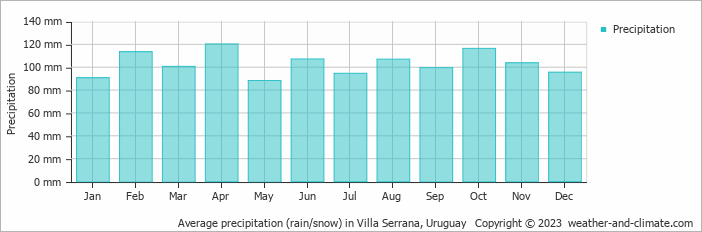
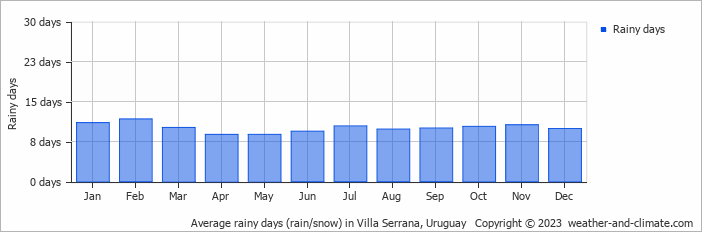
Despite minor fluctuations, Villa Serrana enjoys fairly consistent precipitation throughout the year. In April, you can expect around 120 mm (4.7 in) of precipitation, while in May, Villa Serrana receives about 88 mm (3.5 in).
April, the wettest month, has a maximum daytime temperature of 23°C (73°F). The city receives 185 hours of sunshine in this period. During the driest month May you can expect a temperature of 19°C (66°F). For more detailed insights into the city's temperatures, visit our Villa Serrana Temperature page.
Average daily rainfall for each day of the month based on long-term records. 50-year average (1976-2025)
Browse day-by-day precipitation records for Villa Serrana spanning 51 years. Select any month and year to see actual rainfall and snowfall recorded on each day.
The map below shows the annual precipitation across Uruguay. You can also select the different months in case you are interested in a specific month.
Villa Serrana's average annual precipitation is 1237 mm (49 in). Let's compare this to some popular worldwide tourist destinations:
Seville, Spain, experiences 541 mm (21 in) of rainfall annually, with wet winters and dry summers typical of southern Spain.
In Seoul, South Korea, the average annual precipitation is 1237 mm (49 in), with most rain falling during the summer monsoon season.
Melbourne, Australia, has 690 mm (27 in) of rainfall annually, spread fairly evenly throughout the year.
Singapore, situated near the equator, gets 2581 mm (102 in) of rainfall annually, with no distinct dry season and consistent monthly precipitation.
Precipitation amounts are measured using specific gauges installed at weather stations, collecting both rain and snow and any other type of precipitation. Rainfall is measured directly in millimeters, while that from snow and ice is obtained by melting it. Automated systems often incorporate heaters to make this easier.
Information from these stations is transmitted via Wi-Fi, satellite, GPS, or telephone connections to central monitoring networks. This information is immediately updated and integrated into weather models and forecasts.
For more detailed information about Villa Serrana's weather, including sunshine hours, humidity levels, and temperature data, visit our Villa Serrana Climate page.
Pick a month to see the average temperature, rainfall and sunshine in Villa Serrana - and find the best time to visit.
Temperature Rainfall Sunshine Humidity
See the full Villa Serrana climate overview or explore weather in Uruguay.
Where to go in October - average daytime high across popular destinations.
 Colonia del Sacramento
 21°C (70°F) Montevideo20°C (68°F) La Pedrera19°C (66°F) José Ignacio19°C (66°F) Piriápolis19°C (66°F) La Paloma19°C (66°F) Punta Del Diablo19°C (66°F) Punta del Este18°C (64°F)
 Need travel inspiration? Check out our bucket list articles and be inspired.
The 10 most alternative cities in South America
Discover South America's top 10 alternative cities! From Valparaíso's vibrant streets to La Paz's high-altitude charm and Medellín's innovative spirit.
 Carmelo is the best kept secret of Uruguay
With its natural beauty and history, Carmelo is an inviting place to visit. Enjoy nature, tranquility, authenticity, the 'wine' and activities such as cycling, walking and horse riding.

 Visit the Rainbow Mountains
The Rainbow Mountain (Vinicunca) is acolored rainbow mountain that will steal your heart forever and the view from the top will take your breath away.

 The 5 most tranquil retreats in the Amazon Rainforest, Brazil
Discover top sustainable lodges in the Amazon. Enjoy unique wildlife, eco-friendly stays, and immersive experiences at Anavilhanas, Cristalino, and more.