


















 Warm Sea Without Extreme Heat: 8 Beach Destinations With Comfortable Weather
Love warm seawater but not extreme heat? Compare eight beach destinations where the sea stays warm while daytime temperatures remain comfortable.
This page shows both the average monthly rainfall and the number of rainy days in Paterna, Valencia Community, Spain. The figures are based on a 30-year period (1990–2020) to provide a reliable average. Now, let's break down all the details for a clearer picture.
Paterna has a relatively dry climate with low precipitation, averaging 446 mm (18 in) of rainfall annually. It experiences a distinct dry season during certain months. Refer to our detailed charts below to see the seasonal variation.
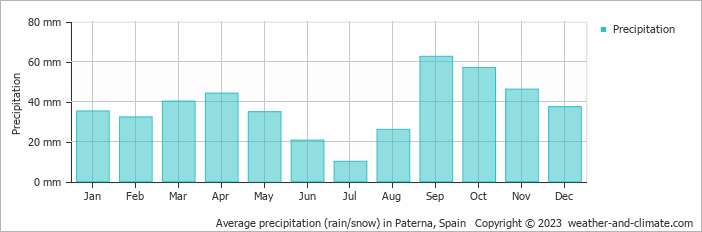

The climate in Paterna shows significant variation throughout the year. Expect 63 mm (2.5 in) of precipitation during the wettest month September, distributed over 6 rainy days.
In contrast, July offers drier and sunnier days, with around 10 mm (0.4 in) of rainfall over 4 rainy days.
September, the wettest month, has a maximum daytime temperature of 28°C (82°F). The city receives 234 hours of sunshine in this period. During the driest month July you can expect a temperature of 31°C (88°F). For more detailed insights into the city's temperatures, visit our Paterna Temperature page.
The map below shows the annual precipitation across Spain. You can also select the different months in case you are interested in a specific month.
Paterna's average annual precipitation is 446 mm (18 in). Let's compare this to some popular worldwide tourist destinations:
Seville, Spain, experiences 541 mm (21 in) of rainfall annually, with wet winters and dry summers typical of southern Spain.
Meanwhile, Buenos Aires, Argentina, enjoys a humid subtropical climate with 1000 mm (39 in) of annual rainfall, mostly in the summer.
Adelaide, Australia, enjoys 511 mm (20 in) of annual precipitation, with dry summers and wet winters.
Bangkok, Thailand, experiences a tropical monsoon climate with 1668 mm (66 in) of annual rainfall, with the heaviest precipitation occurring during September and October.
Precipitation amounts are measured using specific gauges installed at weather stations, collecting both rain and snow and any other type of precipitation. Rainfall is measured directly in millimeters, while that from snow and ice is obtained by melting it. Automated systems often incorporate heaters to make this easier.
Information from these stations is transmitted via Wi-Fi, satellite, GPS, or telephone connections to central monitoring networks. This information is immediately updated and integrated into weather models and forecasts.
Tropical Rainforests: In tropical regions, rainfall is generally abundant year-round. Areas near the equator, like the Amazon rainforest, can receive up to 3000 mm (118 in) of rain annually.
Desert Regions: Deserts such as the Sahara and Arabian deserts typically see less than 250 mm (9.8 in) of rainfall annually. Rainfall tends to be infrequent, but when it does occur, it is often intense.
Temperate Zones: In temperate regions, precipitation tends to be more evenly distributed, though areas closer to the ocean may see more rain in the winter months, and areas further inland experience drier summers.
Polar Regions: Precipitation in polar regions, like Antarctica, is extremely low, often falling as snow. Average annual precipitation in Antarctica is less than 200 mm (7.9 in), with some areas receiving as little as 50 mm (2 in) annually.
For more detailed information about Paterna's weather, including sunshine hours, humidity levels, and temperature data, visit our Paterna Climate page.
Pick a month to see the average temperature, rainfall and sunshine in Paterna - and find the best time to visit.
Temperature Rainfall Sunshine Humidity Water Temp
See the full Paterna climate overview or explore weather in Spain.
Where to go in October - average daytime high across popular destinations.
Need travel inspiration? Check out our bucket list articles and be inspired.
Warm Sea Without Extreme Heat: 8 Beach Destinations With Comfortable Weather
Love warm seawater but not extreme heat? Compare eight beach destinations where the sea stays warm while daytime temperatures remain comfortable.

 El Hierro: The smallest Canary island without mass tourism
Mainly nature lovers and those seeking tranquility go to El Hierro. The island is know for its beautiful mountains and you can wonder around for days here.
 Spain in October: Where Is It Warmest and Sunniest?
Discover where Spain is warmest in October, with climate comparisons for Seville, Alicante, Málaga, Tenerife, Madrid and Barcelona.
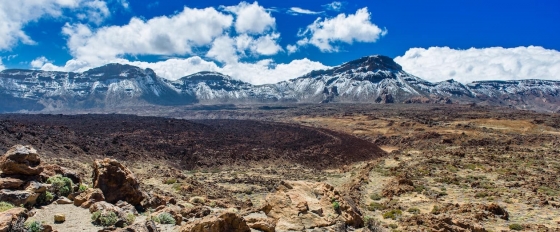 Visit national Park El Teide
This national park is truly a unique place that you should not miss. You will find landscapes that seem to come from another plane and you will feel tiny in these impressive surroundings.