















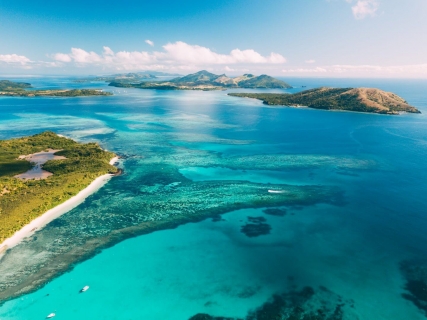
 Explore the Yasawa Islands
The Yasawa islands are known for their tropical beautiful beaches and the picturesque atmosphere. You might want to cross it of your bucket list.
This page shows both the average monthly rainfall and the number of rainy days in Lautoka, Viti Levu, Fiji. The figures are based on a 30-year period (1990–2020) to provide a reliable average. Now, let's break down all the details for a clearer picture.
Lautoka is known for its substantial rainfall, with annual precipitation reaching 1872 mm (74 in). While the overall climate is wet, there are notable seasonal patterns that create interesting contrasts, as demonstrated in our graph below.
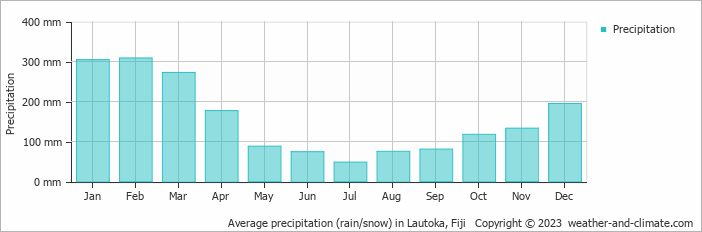
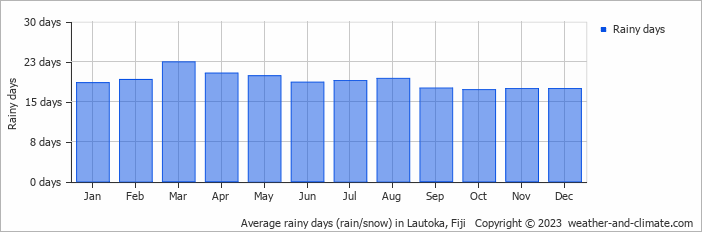
The climate in Lautoka shows significant variation throughout the year. Expect 308 mm (12 in) of precipitation during the wettest month February, distributed over 19 rainy days.
In contrast, July offers drier and sunnier days, with around 48 mm (1.9 in) of rainfall over 19 rainy days.
February, the wettest month, has a maximum daytime temperature of 30°C (86°F). The city receives 184 hours of sunshine in this period. During the driest month July you can expect a temperature of 27°C (81°F). For more detailed insights into the city's temperatures, visit our Lautoka Temperature page.
Average daily rainfall for each day of the month based on long-term records. 50-year average (1976-2025)
Browse day-by-day precipitation records for Lautoka spanning 51 years. Select any month and year to see actual rainfall and snowfall recorded on each day.
The map below shows the annual precipitation across Fiji. You can also select the different months in case you are interested in a specific month.
Lautoka's average annual precipitation is 1872 mm (74 in). Let's compare this to some popular worldwide tourist destinations:
The city of Rome, Italy, has an average annual precipitation of 832 mm (33 in), spread fairly evenly throughout the year.
Osaka, Japan, experiences 1507 mm (59 in) of rainfall annually, spread across the year with wetter summers.
Adelaide, Australia, enjoys 511 mm (20 in) of annual precipitation, with dry summers and wet winters.
Mumbai, India, experiences a tropical monsoon climate with 1860 mm (73 in) of annual rainfall, with the majority of precipitation happening during the monsoon season from June to September.
Precipitation amounts are measured using specific gauges installed at weather stations, collecting both rain and snow and any other type of precipitation. Rainfall is measured directly in millimeters, while that from snow and ice is obtained by melting it. Automated systems often incorporate heaters to make this easier.
Information from these stations is transmitted via Wi-Fi, satellite, GPS, or telephone connections to central monitoring networks. This information is immediately updated and integrated into weather models and forecasts.
Precipitation has a very strong role in determining the local climate and ecosystem:
For more detailed information about Lautoka's weather, including sunshine hours, humidity levels, and temperature data, visit our Lautoka Climate page.
Pick a month to see the average temperature, rainfall and sunshine in Lautoka - and find the best time to visit.
Temperature Rainfall Sunshine Humidity Wind Speed Water Temp
See the full Lautoka climate overview or explore weather in Fiji.
Where to go in October - average daytime high across popular destinations.
Nadi 29°C (84°F) Denarau
 29°C (84°F) Rotuma
 29°C (84°F) Matei27°C (81°F) Savusavu27°C (81°F) Pacific Harbour26°C (79°F) Suva26°C (79°F) Korolevu27°C (81°F)
 Need travel inspiration? Check out our bucket list articles and be inspired.
Explore the Yasawa Islands
The Yasawa islands are known for their tropical beautiful beaches and the picturesque atmosphere. You might want to cross it of your bucket list.

 An alternative way to discover Sydney
We have made an overview of the sights in Sydney that you must see if you want to visit Sydney in an alternative way.
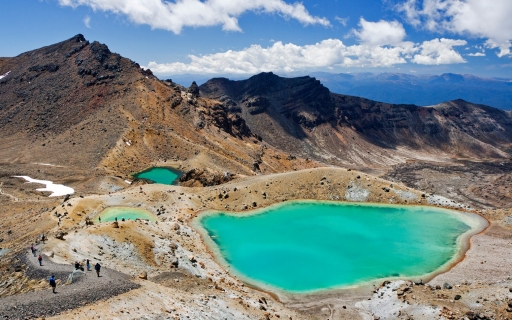
 The Tongariro Crossing in New Zealand
It is called the most beautiful walk in New Zealand, the Tongariro Crossing. The official hiking season starts late October until end of April.
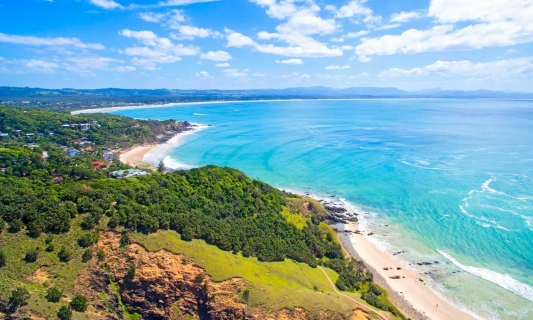 The most relaxed and alternative area of Australia is called the Byron Shire
The Byron Shire is one of the most pretty areas in the world. Not only in terms on natural beauty, also the relaxed vibe and people make this an area that remains close to your heart.