


















 Hike the South West Coast Path
The South West Coast Path means breathtaking nature, kind people and delicious food everywhere you go. It is an unforgettable experience and you need to add it to your bucket list.
This page shows both the average monthly rainfall and the number of rainy days in Haverhill, Suffolk, United Kingdom. The numbers reflect climate data gathered over a 30-year period, from 1990 to 2020. Let's now guide you through the details for a complete overview.
On average, Haverhill receives a reasonable amount of rain/snowfall, with an annual precipitation of 711 mm (28 in).
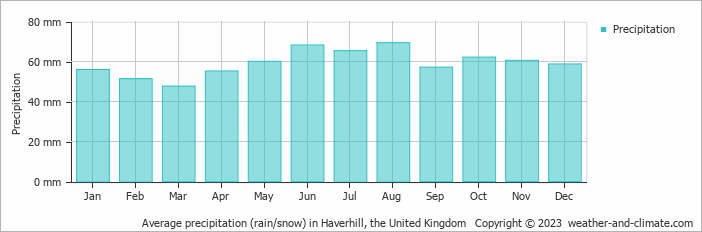
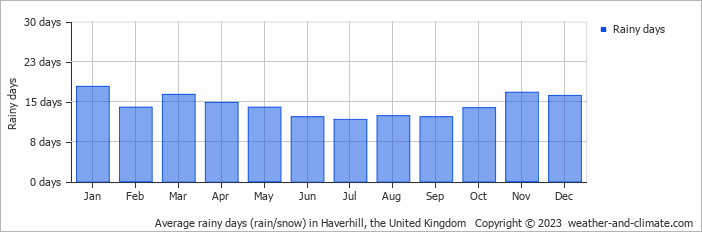
The wettest period in Haverhill occurs in August, which receives around 69 mm (2.7 in) of precipitation. During the driest month, March, Haverhill experiences moderate rainfall, totaling approximately 48 mm (1.9 in). The consistent precipitation levels throughout the year contribute to a relatively stable climate.
August, the wettest month, has a maximum daytime temperature of 23°C (73°F). The city receives 183 hours of sunshine in this period. During the driest month March you can expect a temperature of 11°C (52°F). For more detailed insights into the city's temperatures, visit our Haverhill Temperature page.
The map below shows the annual precipitation across the United Kingdom. You can also select the different months in case you are interested in a specific month.
Haverhill's average annual precipitation is 711 mm (28 in). Let's compare this to some popular worldwide tourist destinations:
In Lisbon, Portugal, the average annual precipitation is 774 mm (30 in), characterized by wet winters and dry summers typical of the Mediterranean climate.
In Seoul, South Korea, the average annual precipitation is 1237 mm (49 in), with most rain falling during the summer monsoon season.
Perth, Australia, receives 565 mm (22 in) of rainfall annually, mostly during the winter months.
Bangkok, Thailand, experiences a tropical monsoon climate with 1668 mm (66 in) of annual rainfall, with the heaviest precipitation occurring during September and October.
Precipitation amounts are measured using specific gauges installed at weather stations, collecting both rain and snow and any other type of precipitation. Rainfall is measured directly in millimeters, while that from snow and ice is obtained by melting it. Automated systems often incorporate heaters to make this easier.
Information from these stations is transmitted via Wi-Fi, satellite, GPS, or telephone connections to central monitoring networks. This information is immediately updated and integrated into weather models and forecasts.
Tropical Rainforests: In tropical regions, rainfall is generally abundant year-round. Areas near the equator, like the Amazon rainforest, can receive up to 3000 mm (118 in) of rain annually.
Desert Regions: Deserts such as the Sahara and Arabian deserts typically see less than 250 mm (9.8 in) of rainfall annually. Rainfall tends to be infrequent, but when it does occur, it is often intense.
Temperate Zones: In temperate regions, precipitation tends to be more evenly distributed, though areas closer to the ocean may see more rain in the winter months, and areas further inland experience drier summers.
Polar Regions: Precipitation in polar regions, like Antarctica, is extremely low, often falling as snow. Average annual precipitation in Antarctica is less than 200 mm (7.9 in), with some areas receiving as little as 50 mm (2 in) annually.
For more detailed information about Haverhill's weather, including sunshine hours, humidity levels, and temperature data, visit our Haverhill Climate page.
Pick a month to see the average temperature, rainfall and sunshine in Haverhill - and find the best time to visit.
Temperature Rainfall Sunshine
See the full Haverhill climate overview or explore weather in the United Kingdom.
Where to go in October - average daytime high across popular destinations.
London 16°C (61°F) Bath15°C (59°F) Torquay16°C (61°F) Manchester14°C (57°F) York15°C (59°F) Blackpool
 15°C (59°F) Edinburgh13°C (55°F) Glasgow14°C (57°F)
 Need travel inspiration? Check out our bucket list articles and be inspired.
Hike the South West Coast Path
The South West Coast Path means breathtaking nature, kind people and delicious food everywhere you go. It is an unforgettable experience and you need to add it to your bucket list.
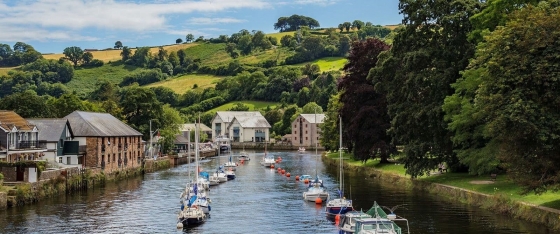 Welcome to Totnes, the hidden treasure of South Devon
Totnes is a place where historical richness fuses effortlessly with a vibrant alternative culture and breathtaking natural surroundings. The town pulses with an amazing community spirit that you'll feel around every corner.
 London's coolest neighborhoods you'll want to visit
Discover the 6 coolest neighborhoods in London for your trip! Explore vibrant Shoreditch, lively Soho, alternative Camden, and many more.
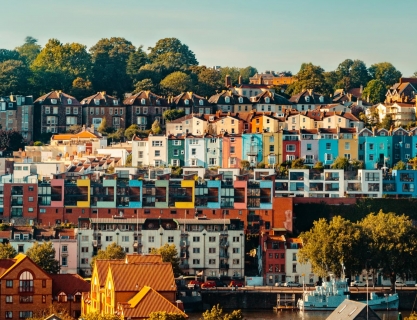 10 cities you should definitely visit in the UK
Discover the top 10 most fun and alternative cities in the UK, rich in art, culture, and adventure. Explore vibrant neighborhoods and unique places.