This page shows both the average monthly rainfall and the number of rainy days in Esenyurt, Marmara Region, Turkey.
The numbers reflect climate data gathered over a 30-year period, from 1990 to 2020.
Now, let's break down all the details for a clearer picture.
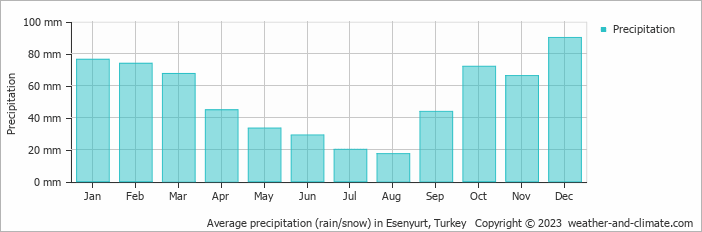
Generally, Esenyurt has a moderate amount of precipitation,
averaging 633 mm (25 in) of rainfall annually.
However, it does experience a distinct dry season during certain months. Take a look at our detailed charts below to see the seasonal variation.
Monthly Rainfall & Rainy Days
Monthly Precipitation Levels
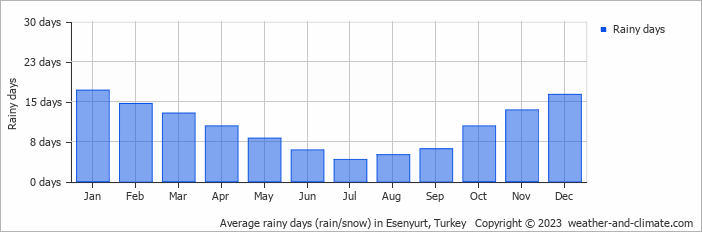
The average number of days each month with precipitation (> 0.2 mm (0.01 in))
Significant seasonal changes in precipitation occur throughout the year.
During the wettest month, December receives substantial rainfall, averaging 90 mm (3.5 in) of precipitation,
recorded across 16 rainy days.
In contrast, the driest month, August brings less rainfall, with 17 mm (0.7 in) over 5 rainy days.
December, the wettest month, has a maximum daytime temperature of 12°C (54°F).
The city receives 61 hours of sunshine in this period.
During the driest month August you can expect a temperature of 29°C (84°F). For more detailed insights into the city's temperatures, visit our Esenyurt Temperature page.
Annual Rainfall in Turkey: City Comparison
The map below shows the annual precipitation across Turkey. You can also select the different months in case you are interested in a specific month.
Avg day temp (°C)
0°32°
Esenyurt vs World: Rainfall Compared
Esenyurt's average annual precipitation is 633 mm (25 in). Let's compare this to some popular worldwide tourist destinations:
In Toronto, Canada, annual precipitation averages 964 mm (38 in), with snowy winters and rainy summers.
In Shanghai, China, the annual average precipitation is 1347 mm (53 in), with a humid subtropical climate.
Perth, Australia, receives 565 mm (22 in) of rainfall annually, mostly during the winter months.
Singapore, situated near the equator, gets 2581 mm (102 in) of rainfall annually, with no distinct dry season and consistent monthly precipitation.
How is Precipitation Measured?
Precipitation amounts are measured using specific gauges installed at weather stations, collecting both rain and snow and any other type of precipitation. Rainfall is measured directly in millimeters, while that from snow and ice is obtained by melting it. Automated systems often incorporate heaters to make this easier.
Information from these stations is transmitted via Wi-Fi, satellite, GPS, or telephone connections to central monitoring networks. This information is immediately updated and integrated into weather models and forecasts.
Rainy Seasons: Many parts of the world have well-defined wet seasons where precipitation is distinctly higher. These are normally accompanied by lush vegetation and temperature patterns.
Dry Seasons: In areas where the climate is either desert or Mediterranean, the amount of precipitation is drastically reduced, leading to a shortage of water and arid conditions.
Interesting weather facts
The U.S. has a significant number of thunderstorms every year, with over 14.6 million taking place across the world annually.
Approximately 70% of lightning bolts strike land rather than oceans.
A storm named John was the longest-lasting Pacific tropical storm, continuing for 31 days. As it crossed the dateline twice, it changed status from a hurricane to a typhoon and back to a hurricane.
For more detailed information about Esenyurt's weather, including sunshine hours, humidity levels, and temperature data, visit our Esenyurt Climate page.
Esenyurt Weather by Month
Pick a month to see the average temperature, rainfall and sunshine in Esenyurt - and find the best time to visit.






















 An idyllic and beautiful place to stay and eat near Saklikent National Park in Turkey