


















 7 of the most budget-friendly destinations in Europe
Discover Europe's top budget-friendly destinations including Budapest, Kotor, Krakow, and more, perfect for affordable and exciting travel.
This page shows both the average monthly rainfall and the number of rainy days in Costa Nova, Centro Region, Portugal. This average is based on long-term data collected between 1990 and 2020. Now, let's explore all the details to give you a full picture.
Costa Nova is known for its substantial rainfall, with annual precipitation reaching 1045 mm (41 in). While the overall climate is wet, there are notable seasonal patterns that create interesting contrasts, as demonstrated in our graph below.
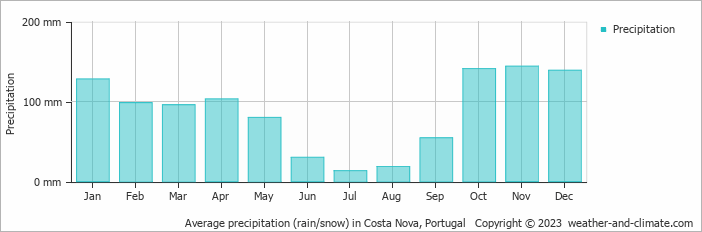
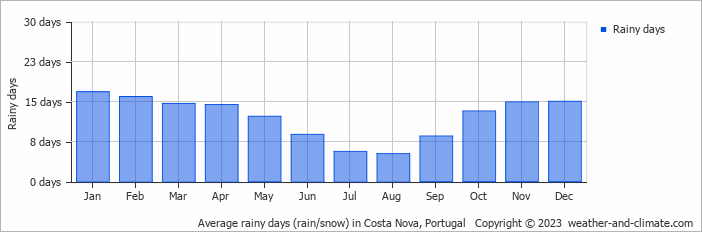
Costa Nova can be quite wet during November, receiving approximately 144 mm (5.7 in) of precipitation over 15 rainy days.
In contrast July, experiences much drier conditions, with 13 mm (0.5 in) of rainfall, spread across 6 rainy days.
November, the wettest month, has a maximum daytime temperature of 18°C (64°F). The city receives 149 hours of sunshine in this period. During the driest month July you can expect a temperature of 25°C (77°F). For more detailed insights into the city's temperatures, visit our Costa Nova Temperature page.
The map below shows the annual precipitation across Portugal. You can also select the different months in case you are interested in a specific month.
Costa Nova's average annual precipitation is 1045 mm (41 in). Let's compare this to some popular worldwide tourist destinations:
In Toronto, Canada, annual precipitation averages 964 mm (38 in), with snowy winters and rainy summers.
Beijing, China, receives 560 mm (22 in) of annual precipitation, concentrated in the summer months.
Adelaide, Australia, enjoys 511 mm (20 in) of annual precipitation, with dry summers and wet winters.
Singapore, situated near the equator, gets 2581 mm (102 in) of rainfall annually, with no distinct dry season and consistent monthly precipitation.
Precipitation amounts are measured using specific gauges installed at weather stations, collecting both rain and snow and any other type of precipitation. Rainfall is measured directly in millimeters, while that from snow and ice is obtained by melting it. Automated systems often incorporate heaters to make this easier.
Information from these stations is transmitted via Wi-Fi, satellite, GPS, or telephone connections to central monitoring networks. This information is immediately updated and integrated into weather models and forecasts.
Precipitation has a very strong role in determining the local climate and ecosystem:
For more detailed information about Costa Nova's weather, including sunshine hours, humidity levels, and temperature data, visit our Costa Nova Climate page.
Pick a month to see the average temperature, rainfall and sunshine in Costa Nova - and find the best time to visit.
Temperature Rainfall Sunshine Humidity
See the full Costa Nova climate overview or explore weather in Portugal.
Where to go in October - average daytime high across popular destinations.
Need travel inspiration? Check out our bucket list articles and be inspired.
7 of the most budget-friendly destinations in Europe
Discover Europe's top budget-friendly destinations including Budapest, Kotor, Krakow, and more, perfect for affordable and exciting travel.

 Warm Sea Without Extreme Heat: 8 Beach Destinations With Comfortable Weather
Love warm seawater but not extreme heat? Compare eight beach destinations where the sea stays warm while daytime temperatures remain comfortable.

 Alentejo, where time stands still
The quiet region is known for its rolling green hills and it is a true hiking paradise. Architectural highlights can be found in the castles, ancient monasteries or when exploring the countless charming villages.
 An eco-friendly guide to Lagos travel
Lagos, Portugal is a great place to visit while being careful about your environmental footprint. Here you find some tips about environmentally places to stay, where to eat and how to get around in the area.