
Dease Lake (BC) Monthly Rainfall & Precipitation
This page shows both the average monthly rainfall and the number of rainy days in Dease Lake, British Columbia, Canada. The figures are based on a 30-year period (1990–2020) to provide a reliable average. Let's explore the details to provide you with a complete overview.
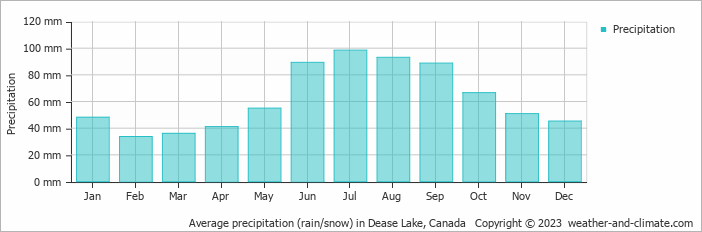
Generally, Dease Lake receives mid-range precipitation levels, with 746 mm (29 in) annually. The distribution varies significantly throughout the year, with a distinct dry season during certain months, as shown in our charts below.
Monthly Rainfall & Rainy Days
Monthly Precipitation Levels
The average number of days each month with precipitation (> 0.2 mm (0.01 in))
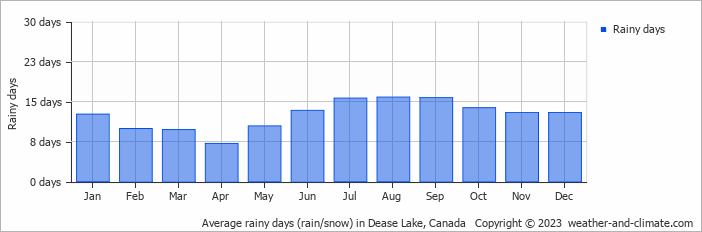
Significant seasonal changes in precipitation occur throughout the year. During the wettest month, July receives substantial rainfall, averaging 98 mm (3.9 in) of precipitation, recorded across 16 rainy days.
In contrast, the driest month, February brings less snowfall, with 34 mm (1.3 in) over 10 snowy days.
July, the wettest month, has a maximum daytime temperature of 17°C (63°F). The city receives 210 hours of sunshine in this period. During the driest month February you can expect a temperature of -7°C (19°F). For more detailed insights into the city's temperatures, visit our Dease Lake Temperature page.
Daily Historical Precipitation
Average daily rainfall for each day of the month based on long-term records. 48-year average (1976-2025)
Average precipitation in September
Explore Dease Lake's Historical Precipitation: 1976-2026
Browse day-by-day precipitation records for Dease Lake spanning 51 years. Select any month and year to see actual rainfall and snowfall recorded on each day.
Annual Rainfall in Canada: City Comparison
The map below shows the annual precipitation across Canada. You can also select the different months in case you are interested in a specific month.
Dease Lake vs World: Rainfall Compared
Dease Lake's average annual precipitation is 746 mm (29 in). Let's compare this to some popular worldwide tourist destinations:
In Toronto, Canada, annual precipitation averages 964 mm (38 in), with snowy winters and rainy summers.
In Shanghai, China, the annual average precipitation is 1347 mm (53 in), with a humid subtropical climate.
In Tokyo, Japan, the average annual precipitation is 1528 mm (60 in), with significant summer rains due to typhoon season.
Mumbai, India, experiences a tropical monsoon climate with 1860 mm (73 in) of annual rainfall, with the majority of precipitation happening during the monsoon season from June to September.
Precipitation amounts are measured using specific gauges installed at weather stations, collecting both rain and snow and any other type of precipitation. Rainfall is measured directly in millimeters, while that from snow and ice is obtained by melting it. Automated systems often incorporate heaters to make this easier.
Information from these stations is transmitted via Wi-Fi, satellite, GPS, or telephone connections to central monitoring networks. This information is immediately updated and integrated into weather models and forecasts.
The proximity of a location to a large body of water can significantly affect its rainfall patterns:
- Ocean Influence: Coastal regions typically receive more rainfall due to the presence of moisture-laden winds from the ocean. These regions tend to have more humid climates and experience more frequent precipitation, especially in winter.
- Continental Climates: Areas further from the sea, such as inland or continental regions, experience less frequent rainfall and more extreme seasonal variations in precipitation.
- "Ginger" was the longest-lasting Atlantic tropical storm, which spun around the open ocean for 28 days in 1971.
- The world's largest snowflake was recorded in the Guinness Book of Records, at 38 cm (15 inches) wide and 20 cm (7.9 inches) thick. The snowflake fell at Fort Keogh, Montana, USA, on 28 January 1887.
- The greatest snowfall recorded was on Mt. Rainier, Washington State, USA, over 31.5 meters (103 feet) fell during the winter of 1972.
For more detailed information about Dease Lake (BC)'s weather, including sunshine hours, humidity levels, and temperature data, visit our Dease Lake (BC) Climate page.
Dease Lake Weather by Month
Pick a month to see the average temperature, rainfall and sunshine in Dease Lake - and find the best time to visit.
Dease Lake 3-Day Forecast
Temperature Rainfall Sunshine Wind Speed
See the full Dease Lake climate overview or explore weather in Canada.
Popular in September
Where to go in September - average daytime high across popular destinations.
 Toronto
 22°C (72°F) Niagara Falls23°C (73°F) Montréal
 22°C (72°F) Ottawa22°C (72°F) Quebec City
 20°C (68°F) Vancouver19°C (66°F) Calgary19°C (66°F) Whistler15°C (59°F)















Bucket list
Need travel inspiration? Check out our bucket list articles and be inspired.
The 5 most beautiful lakes in Canada
Explore Canada's stunning lakes: Lake Louise, Lake Superior, Maligne Lake, Emerald Lake, and Lake Okanagan, each offering unique beauty and activities.
Canoeing the south Nahannii
The South Nahanni in the northwest of Canada is one of the most impressive wilderness rivers in the world. Canoeing the south Nahanni is something you must add to your bucket list.
See Polar Bears in Churchill Canada
Thousands of bears gather at the small town of Churchill. In the evening the northern lights give a light show against the dark evening sky. An unforgettable experience.
Banff National Park
Snowy mountains, clear blue lakes and green forests make Banff National Park a wonderful bucket list destination. The pristine wilderness is a mecca for walkers.