


















 Cockscomb basin wildlife sanctuary
The Cockscomb Basin Wildlife Sanctuary is located in the south of Belize and is said to be the best place on earth to encounter a jaguar. Something you migh want to add to your bucket list.
This page shows both the average monthly rainfall and the number of rainy days in Cockscomb Basin Wildlife Sanctuary, Belize. The figures are based on a 30-year period (1990–2020) to provide a reliable average. Now, let's break down all the details for a clearer picture.
Cockscomb Basin Wildlife Sanctuary has a notably wet climate with abundant precipitation, recording 1671 mm (66 in) of rainfall per year. It does, however, have a distinct rainy season during certain months. Have a look at our detailed charts below to see how precipitation varies throughout the year.
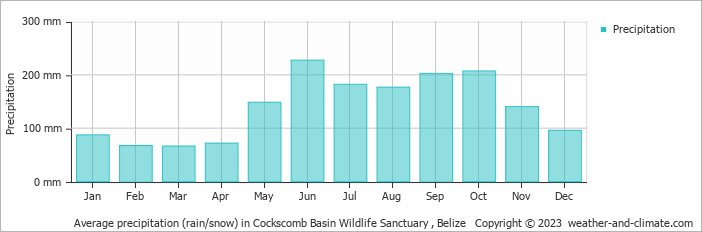
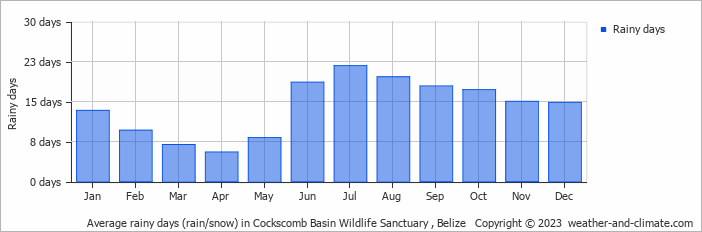
Significant seasonal changes in precipitation occur throughout the year. During the wettest month, June receives substantial rainfall, averaging 227 mm (8.9 in) of precipitation, recorded across 19 rainy days.
In contrast, the driest month, March brings less rainfall, with 66 mm (2.6 in) over 7 rainy days.
June, the wettest month, has a maximum daytime temperature of 31°C (88°F). The city receives 201 hours of sunshine in this period. During the driest month March you can expect a temperature of 29°C (84°F). For more detailed insights into the city's temperatures, visit our Cockscomb Basin Wildlife Sanctuary Temperature page.
Browse day-by-day precipitation records for Cockscomb Basin Wildlife Sanctuary spanning 21 years. Select any month and year to see actual rainfall and snowfall recorded on each day.
The map below shows the annual precipitation across Belize. You can also select the different months in case you are interested in a specific month.
Cockscomb Basin Wildlife Sanctuary's average annual precipitation is 1671 mm (66 in). Let's compare this to some popular worldwide tourist destinations:
In Barcelona, Spain, the average annual precipitation is 620 mm (24 in), evenly distributed across the year with no extreme wet or dry seasons.
Beijing, China, receives 560 mm (22 in) of annual precipitation, concentrated in the summer months.
In Brisbane, Australia, the annual precipitation is 979 mm (39 in), making it wetter than Sydney.
Mumbai, India, experiences a tropical monsoon climate with 1860 mm (73 in) of annual rainfall, with the majority of precipitation happening during the monsoon season from June to September.
Precipitation amounts are measured using specific gauges installed at weather stations, collecting both rain and snow and any other type of precipitation. Rainfall is measured directly in millimeters, while that from snow and ice is obtained by melting it. Automated systems often incorporate heaters to make this easier.
Information from these stations is transmitted via Wi-Fi, satellite, GPS, or telephone connections to central monitoring networks. This information is immediately updated and integrated into weather models and forecasts.
Precipitation has a very strong role in determining the local climate and ecosystem:
For more detailed information about Cockscomb Basin Wildlife Sanctuary's weather, including sunshine hours, humidity levels, and temperature data, visit our Cockscomb Basin Wildlife Sanctuary Climate page.
Pick a month to see the average temperature, rainfall and sunshine in Cockscomb Basin Wildlife Sanctuary - and find the best time to visit.
Temperature Rainfall Sunshine
See the full Cockscomb Basin Wildlife Sanctuary climate overview or explore weather in Belize.
Where to go in October - average daytime high across popular destinations.
San Ignacio 31°C (88°F) Dangriga30°C (86°F) Belize City30°C (86°F) Hopkins30°C (86°F) Maya Beach30°C (86°F) Caye Caulker30°C (86°F) Placencia Village30°C (86°F) San Pedro29°C (84°F)
 Need travel inspiration? Check out our bucket list articles and be inspired.
Cockscomb basin wildlife sanctuary
The Cockscomb Basin Wildlife Sanctuary is located in the south of Belize and is said to be the best place on earth to encounter a jaguar. Something you migh want to add to your bucket list.
 Best Spring Break Destinations for Great Weather and Fewer Crowds
Skip crowded spring break resorts. Compare March weather and travel style in Puerto Escondido, San Juan del Sur, Roatán, Caye Caulker and Curaçao.
 Dive and feel like Robinson Crusoe at Glover’s Reef
Belize has an amazing number of beautiful small islands. Many of these islands are unaffordable for the average backpacker. Glovers Reef is an exception to this.
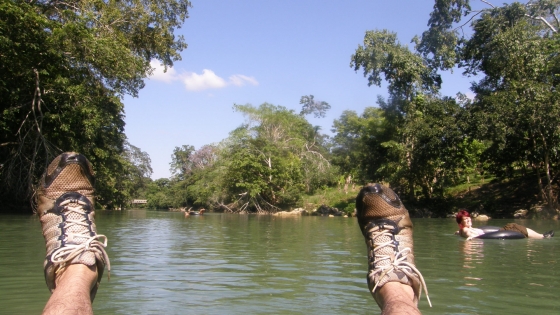 River Tube in Belize
The best time to visit Belize and to River Tube is from December to mid-April, this is the dry season. If you like to avoid the crowds we recommend visiting May and early June.