The amount of sunshine is fundamental to comprehending a place's climate.
This page shows the total number of hours of direct sunlight per month and the average hours per day in Maria Wörth, Carinthia, Austria.
These values are calculated using 30 years of data (1990–2020) to ensure accuracy.
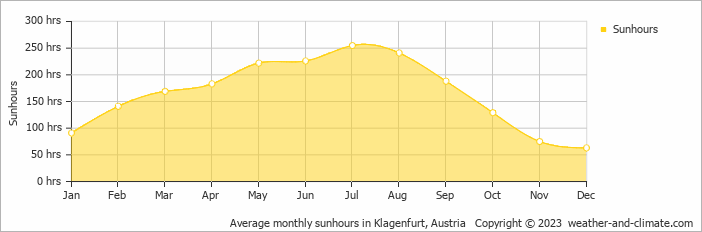
Monthly hours of sunshine
Data from: Klagenfurt, Austria (13 KM, 8 Miles).
Sunshine in Maria Wörth varies greatly throughout the year.
The sunniest month, July, reaches an impressive 255 hours,
while December, the darkest month, offers only 63 hours.
The total annual amount of sun is 1983 hours.
Daily hours of sunshine
Data from: Klagenfurt, Austria (13 KM, 8 Miles).
Seasonal changes in sunshine hours are quite obvious in Maria Wörth.
While July receives considerable daily sunshine
with up to 8.5 hours,
December marks the darkest time of the year,
where sunshine is scarce with only 2.1 hours of sunlight per day.
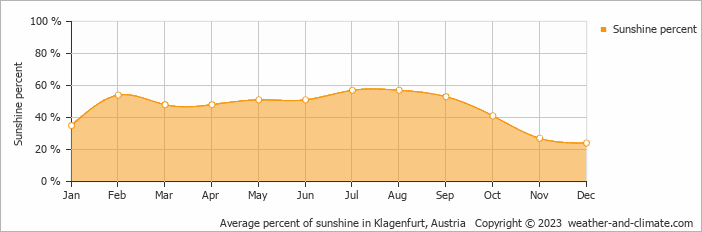
Average percent of sunshine
Data from: Klagenfurt, Austria (13 KM, 8 Miles).
On average the sun shines 57% of the time during the day in July, the highest percentage of any month.
December has the lowest percentage at 24%.




















 Ski Arlberg is the snow mecca of the Alps