














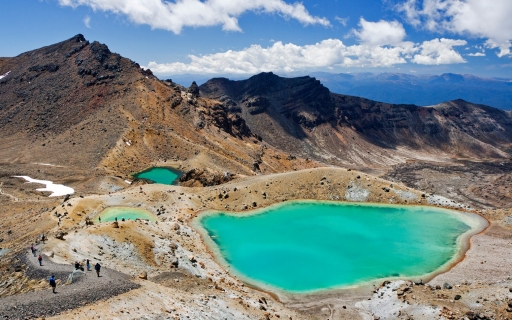
 The Tongariro Crossing in New Zealand
It is called the most beautiful walk in New Zealand, the Tongariro Crossing. The official hiking season starts late October until end of April.
To truly understand a climate, we must look at its sunshine. This page shows the total number of hours of direct sunlight per month and the average hours per day in Invercargill, Southland, New Zealand. These values are calculated using 30 years of data (1990–2020) to ensure accuracy.
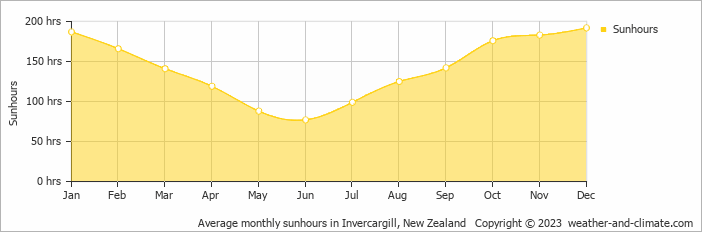
Sunshine in Invercargill varies greatly throughout the year. The sunniest month, December, reaches an impressive 192 hours, while June, the darkest month, offers only 77 hours. The total annual amount of sun is 1695 hours.
For those who appreciate different seasons, Invercargill serves as an ideal destination. Expect longer, more sun-filled days in December with an average of 6.4 hours of sunshine daily, and embrace the darker days in June, offering only 2.6 hours of daily sunlight.
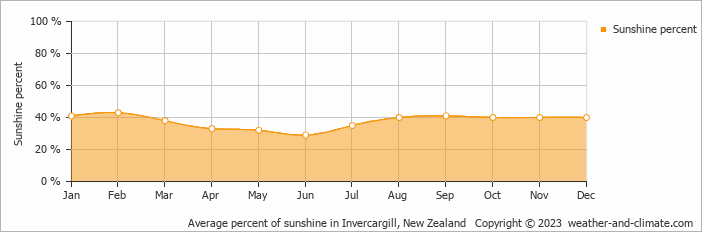
On average the sun shines 43% of the time during the day in February, the highest percentage of any month. June has the lowest percentage at 29%.
Invercargill enjoys an average of 1695 hours of sunshine annually. Let’s compare this with some popular tourist destinations:
The city of Rome, Italy, experiences 2470 hours of sunshine annually, adding to its charm as a year-round tourist destination.
In contrast, Tromsø , Norway, receives only about 1270 hours of sunshine per year, known for the polar night with no sunlight for weeks during winter.
Beijing, China, has 2505 hours of sunshine annually, with clear, sunny days in winter.
Melbourne, Australia, has 2380 hours of sunshine annually, with its famous “four seasons in a day” weather pattern.
October, Invercargill’s wettest month, receives 127 mm (5 in) of rainfall and has a maximum daytime temperature of 15°C (59°F). During the driest month July you can expect a temperature of 11°C (52°F).
For more detailed insights into the city’s temperatures, check out our Temperature page. To explore more about precipitation patterns, visit our Invercargill Precipitation page.
Pick a month to see the average temperature, rainfall and sunshine in Invercargill - and find the best time to visit.
Temperature Rainfall Sunshine Humidity Wind Speed Water Temp
See the full Invercargill climate overview or explore weather in New Zealand.
Where to go in October - average daytime high across popular destinations.
Paihia 18°C (64°F) Auckland
 18°C (64°F) Rotorua
 17°C (63°F) Christchurch17°C (63°F) Nelson
 16°C (61°F) Taupo16°C (61°F) Wellington15°C (59°F) Queenstown
 9°C (48°F)
 Need travel inspiration? Check out our bucket list articles and be inspired.
The Tongariro Crossing in New Zealand
It is called the most beautiful walk in New Zealand, the Tongariro Crossing. The official hiking season starts late October until end of April.
 White-water sledge and raft in Rotorua
We recommend to white-water sledge and raft in Rotorua in summer (January, February) when the Glacier melt fills the rivers. This is the best time.
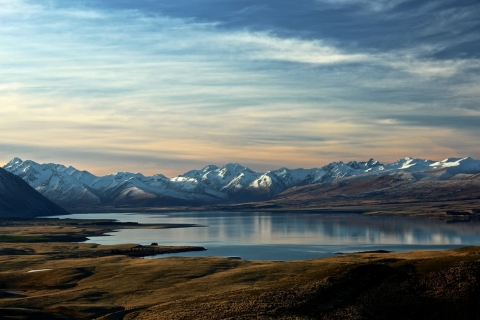 New Zealand in February: North Island or South Island?
Compare New Zealand weather in February for Auckland, Rotorua, Taupo, Christchurch and Queenstown to see which island has the best conditions.

 An alternative way to discover Sydney
We have made an overview of the sights in Sydney that you must see if you want to visit Sydney in an alternative way.