
















 Gozo, the best kept secret of the Mediterranean
Gozo is much quieter and smaller than Malta and therefore more authentic. Many Maltese use Gozo as their holiday island.
Average temperatures, rainfall, sunshine and the best time to visit Żejtun.
 –
–
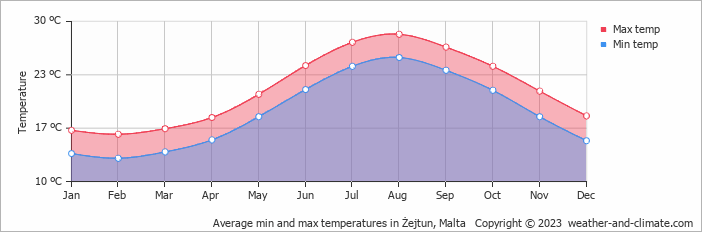
The climate in Żejtun, Malta, Malta, is marked by large temperature swings across the seasons, ranging from 28°C (82°F) in August to 16°C (61°F) in February.
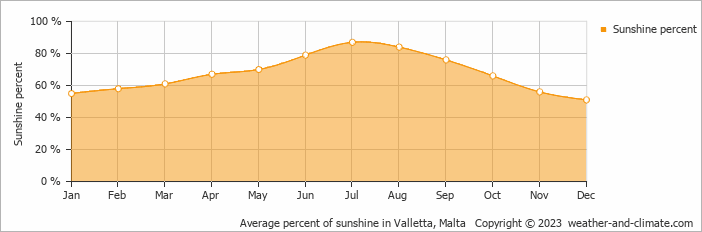
Rainfall is modest, totalling around 432 mm (17 in) annually. The city experiences a distinct dry season from March to September, with warm summers and mild winters. December tends to be the wettest month. Sunshine peaks in July, when the city sees around 12.4 hours of sunshine per day.
Pick a month to see the average temperature, rainfall and sunshine in Żejtun - and find the best time to visit.
In Żejtun, temperatures differ significantly between summer and winter months. Average maximum daytime temperatures range from a comfortable 28°C (82°F) in August, the warmest time of the year, to a moderate 16°C (61°F) during cooler months like February.
At night, you can expect temperatures ranging from 26°C (79°F) in August to around 13°C (55°F) during February.
Check out our detailed temperature page for more information.
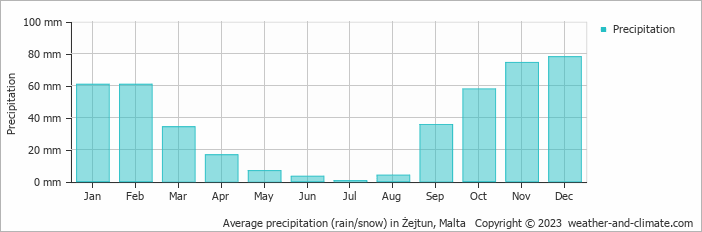
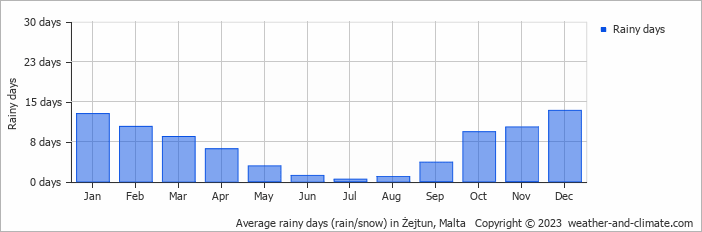
Żejtun tends toward drier weather patterns, receiving approximately 432 mm (17 in) of rain per year. Significant seasonal changes in precipitation occur throughout the year. In the wettest month, December it receives moderate rainfall, averaging 78 mm (3.1 in) of precipitation, recorded across 13 rainy days. In contrast, the driest month July brings less rainfall, with 0.5 mm (0.02 in) over 0 rainy days. For more details, please visit our Żejtun Precipitation page.
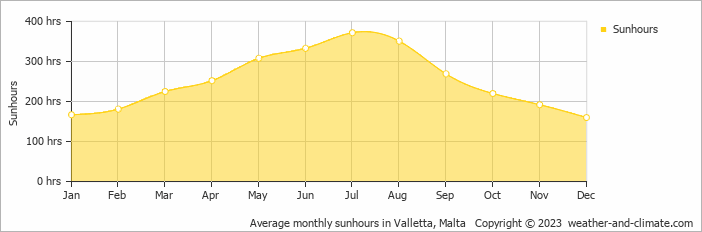
Seasonal changes in sunshine hours are quite dramatic in Żejtun. While July receives considerable daily sunshine with up to 12.4 hours, December marks the darkest time of the year, where sunshine is scarce with only 5.3 hours of sunlight per day.
Visit our detailed sunshine hours page for more information.
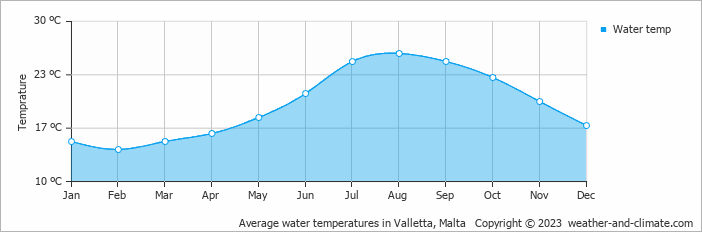
The mean water temperature over the year ranges from 14°C (57°F) in February to 26°C (79°F) in August.
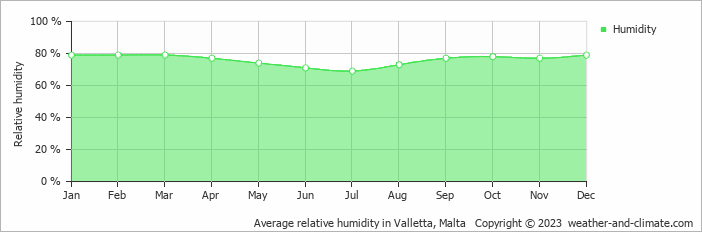
The relative humidity is high throughout the year in Żejtun.
The city experiences its highest humidity in January, reaching 79%. In July, the humidity drops to its lowest level at 69%. What does this mean? Read our detailed page on humidity levels for further details.
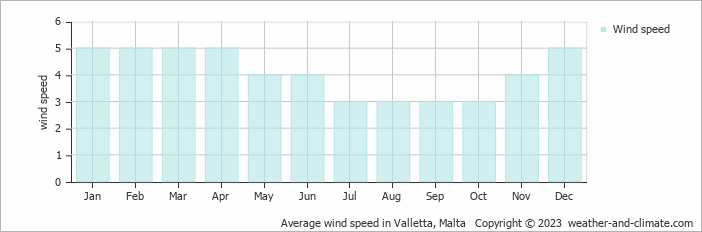
The mean wind speed over the year ranges from 3 m/s (6 knots) in July, August, September and October to 5 m/s (10 knots) in January, February, March, April and December. What does this mean?
Monthly ratings reflect general weather comfort, based on daytime temperature and rainfall. Swimming and winter conditions are highlighted separately where relevant.
April, May, June, July, August, September, October and November typically offer the most optimal weather in Żejtun. In contrast, January, February and March tend to have less optimal conditions. Żejtun has a distinct dry season from March to September, with warm summers and mild winters.
Daytime highs range from 16°C (61°F) in February to 28°C (82°F) in August. Nighttime lows range from 13°C (55°F) to 26°C (79°F). Temperatures vary considerably through the year.
Annual rainfall is around 432 mm (17 in). December is the wettest month with 78 mm (3.1 in), while July is the driest with 0.5 mm (0.02 in).
Żejtun receives around 3,030 hours of sunshine per year. July is the sunniest month with 372 hours, while December is the cloudiest with just 160 hours. Overall, Żejtun enjoys abundant sunshine.
Żejtun is highlighted - select any city to see its climate.
Where to go in October - average daytime high across popular destinations.
Marsaskala 24°C (75°F) Qawra24°C (75°F) Marsalforn24°C (75°F) Xagħra24°C (75°F) Mellieħa24°C (75°F) Sliema24°C (75°F) Valletta24°C (75°F) St Julian's24°C (75°F)
 Need travel inspiration? Check out our bucket list articles and be inspired.
Gozo, the best kept secret of the Mediterranean
Gozo is much quieter and smaller than Malta and therefore more authentic. Many Maltese use Gozo as their holiday island.
 Discover the unique charm of Malta
This small island nation in the Mediterranean Sea has something for everyone, from endless festivals and celebrations to charming villages and stunning coastal views.
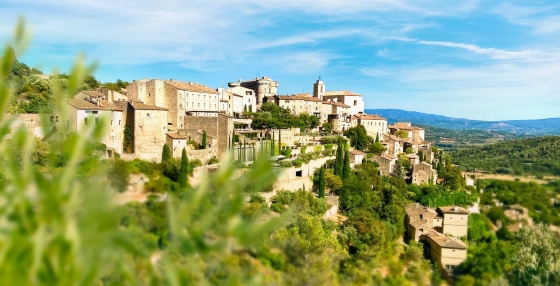
 The 10 most charming villages in France
Discover France's top 10 beautiful villages. From Normandy to the Côte d'Azur, experience quaint squares and cobbled streets. Which one will you visit this summer?

 The train journey from Bucharest to Brasov is one of the most beautiful in Romania
In three hours, you'll get from Bucharest to Brasov by train. It is one of the most beautiful routes in Romania, certainly the most beautiful that can be done by express train.