














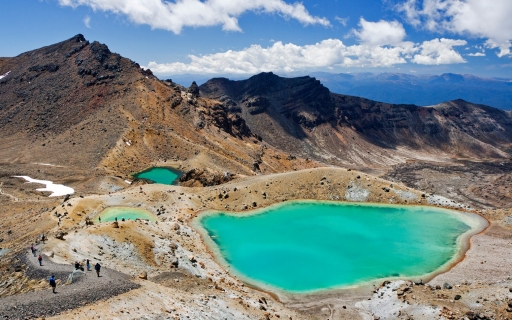
 The Tongariro Crossing in New Zealand
It is called the most beautiful walk in New Zealand, the Tongariro Crossing. The official hiking season starts late October until end of April.
Average temperatures, rainfall, sunshine and the best time to visit Wanaka.
 –
–
Wanaka, in New Zealand's Otago region, swings from pleasant summers to cold winters with significant seasonal changes. The area gets plenty of rain and snow throughout the year, depending on the season. This lake town attracts visitors with its beautiful mountain views and serves as an acces point to both summer hiking trails and winter ski fields at Treble Cone and Cardrona. Let's explore the climate details to provide you with a complete overview on when to visit.
Pick a month to see the average temperature, rainfall and sunshine in Wanaka - and find the best time to visit.
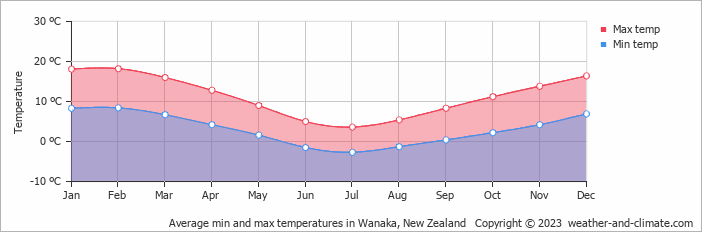
Depending on the time of the year, temperatures range from pleasant to chilly in Wanaka. Average daytime temperatures reach a pleasant 18°C (64°F) in February. In July, the coolest month of the year, temperatures drop to a chilly 4°C (39°F).
At night, temperatures range from around 8°C (46°F) in February to -3°C (27°F) in July.
Check out our detailed temperature page for more information.
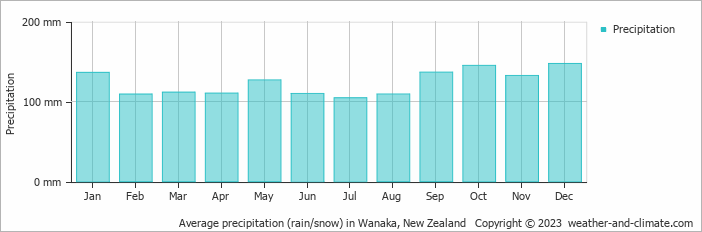
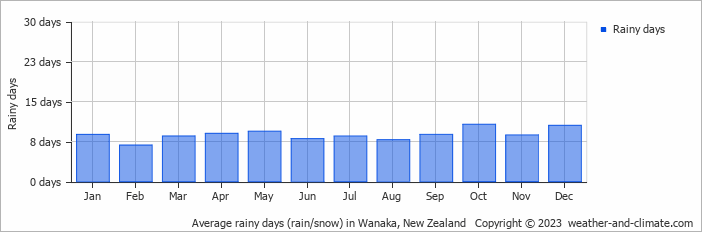
Wanaka has a relatively rain/snowy climate with high precipitation levels, averaging 1478 mm (58 in) of rain/snowfall annually. Despite minor fluctuations, Wanaka enjoys fairly consistent precipitation throughout the year. In December, you can expect around 147 mm (5.8 in) of precipitation, while in July, Wanaka receives about 104 mm (4.1 in). For more details, please visit our Wanaka Precipitation page.
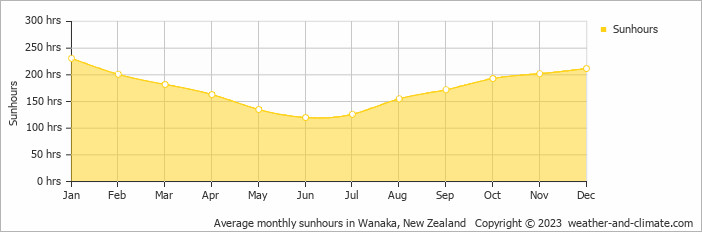
Wanaka can be enjoyed more throughout the sunniest month of January under a blue sky, with approximately 7.7 hours of sunshine daily. In contrast, the city experiences much darker days in June, with only 4.0 hours of sunlight per day.
Visit our detailed sunshine hours page for more information.
Monthly ratings reflect general weather comfort, based on daytime temperature and rainfall. Swimming and winter conditions are highlighted separately where relevant.
January and February typically offer the most optimal weather in Wanaka. In contrast, April, May, June, July, August, September and October tend to have less optimal conditions. Wanaka has pleasant summers and cold winters.
Daytime highs range from 4°C (39°F) in July to 18°C (64°F) in February. Nighttime lows range from -3°C (27°F) to 8°C (46°F). Temperatures vary considerably through the year.
Annual rainfall is around 1478 mm (58 in). December is the wettest month with 147 mm (5.8 in), while July is the driest with 104 mm (4.1 in).
Wanaka receives around 2,092 hours of sunshine per year. January is the sunniest month with 231 hours, while June is the cloudiest with just 120 hours. Overall, Wanaka enjoys abundant sunshine.
Wanaka is highlighted - select any city to see its climate.
Where to go in October - average daytime high across popular destinations.
Paihia18°C (64°F) Auckland 18°C (64°F) Rotorua
 17°C (63°F) Christchurch17°C (63°F) Nelson
 16°C (61°F) Taupo16°C (61°F) Wellington15°C (59°F) Queenstown
 9°C (48°F)
 Need travel inspiration? Check out our bucket list articles and be inspired.
The Tongariro Crossing in New Zealand
It is called the most beautiful walk in New Zealand, the Tongariro Crossing. The official hiking season starts late October until end of April.
 White-water sledge and raft in Rotorua
We recommend to white-water sledge and raft in Rotorua in summer (January, February) when the Glacier melt fills the rivers. This is the best time.
 New Zealand in February: North Island or South Island?
Compare New Zealand weather in February for Auckland, Rotorua, Taupo, Christchurch and Queenstown to see which island has the best conditions.

 An alternative way to discover Sydney
We have made an overview of the sights in Sydney that you must see if you want to visit Sydney in an alternative way.