

















 The 10 most alternative cities in South America
Discover South America's top 10 alternative cities! From Valparaíso's vibrant streets to La Paz's high-altitude charm and Medellín's innovative spirit.
Average temperatures, rainfall, sunshine and the best time to visit Tacuarembó.
 –
–
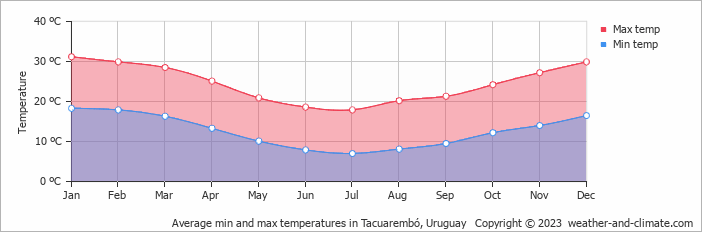
Tacuarembó, Canelones, Uruguay, sees big temperature differences between seasons, with January peaking at 31°C (88°F) and July dropping to 18°C (64°F).
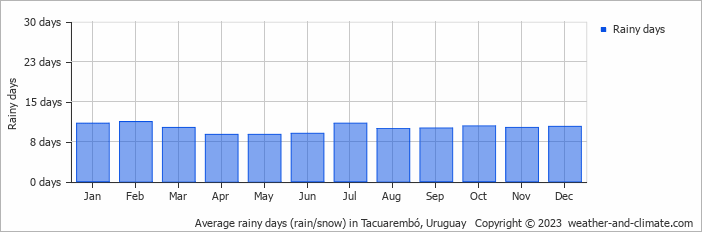
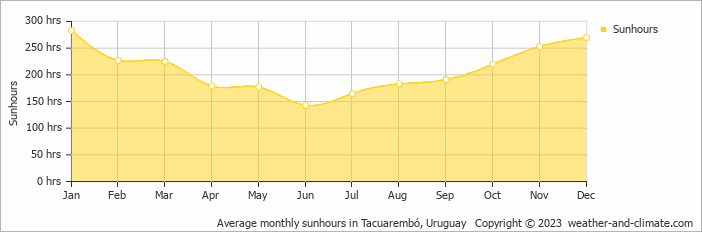
The city has a wet climate, receiving around 1430 mm (56 in) of rainfall per year. Despite the high annual total, it has very warm summers and mild winters. April is the wettest month. The most sunshine falls in January, with an average of 9.4 hours of daily sunshine.
Pick a month to see the average temperature, rainfall and sunshine in Tacuarembó - and find the best time to visit.
Visitors to Tacuarembó can expect significant temperature changes throughout the year. On average, daytime temperatures range from a very warm 31°C (88°F) in January to a moderate 18°C (64°F) in July.
Nighttime temperatures range from 18°C (64°F) in January to 7°C (45°F) in July.
Check out our detailed temperature page for more information.
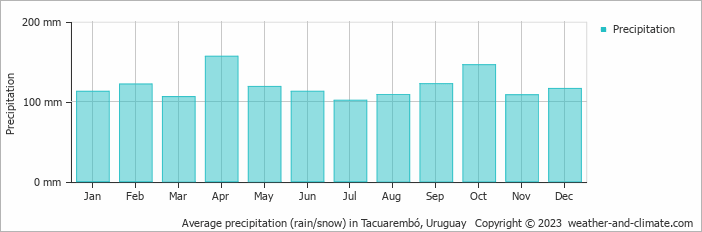
Tacuarembó is known for its substantial rainfall, with annual precipitation reaching 1430 mm (56 in). The wettest period in Tacuarembó occurs in April, which receives around 156 mm (6.1 in) of precipitation. During the driest month, July, Tacuarembó experiences high rainfall, totaling 101 mm (4 in). The consistent precipitation levels throughout the year contribute to a relatively stable climate. For more details, please visit our Tacuarembó Precipitation page.
In Tacuarembó, summer days are longer and more sunny, with daily sunshine hours peaking at 9.4 hours in January. As the darker season arrives, the brightness of the sun becomes less. June sees a soft sun for only 4.8 hours per average day.
Visit our detailed sunshine hours page for more information.
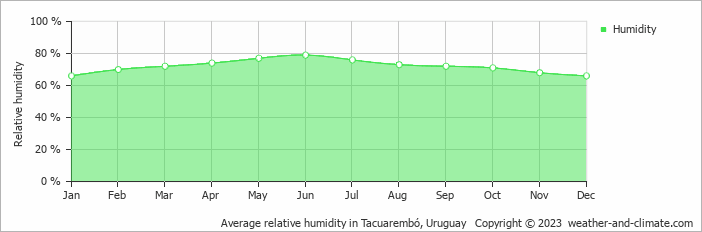
The relative humidity is high throughout the year in Tacuarembó.
The city experiences its highest humidity in June, reaching 79%. In January, the humidity drops to its lowest level at 66%. What does this mean? Read our detailed page on humidity levels for further details.
Monthly ratings reflect general weather comfort, based on daytime temperature and rainfall. Swimming and winter conditions are highlighted separately where relevant.
March, April, May, August, September, October and November typically offer the most optimal weather in Tacuarembó. In contrast, January, February and December tend to have less optimal conditions. Tacuarembó has very warm summers and mild winters.
Daytime highs range from 18°C (64°F) in July to 31°C (88°F) in January. Nighttime lows range from 7°C (45°F) to 18°C (64°F). Temperatures vary considerably through the year.
Annual rainfall is around 1430 mm (56 in). April is the wettest month with 156 mm (6.1 in), while July is the driest with 101 mm (4 in).
Tacuarembó receives around 2,516 hours of sunshine per year. January is the sunniest month with 283 hours, while June is the cloudiest with just 143 hours. Overall, Tacuarembó enjoys abundant sunshine.
Tacuarembó is highlighted - select any city to see its climate.
Where to go in October - average daytime high across popular destinations.
 Colonia del Sacramento
 21°C (70°F) Montevideo20°C (68°F) La Pedrera19°C (66°F) José Ignacio19°C (66°F) Piriápolis19°C (66°F) La Paloma19°C (66°F) Punta Del Diablo19°C (66°F) Punta del Este18°C (64°F)
 Need travel inspiration? Check out our bucket list articles and be inspired.
The 10 most alternative cities in South America
Discover South America's top 10 alternative cities! From Valparaíso's vibrant streets to La Paz's high-altitude charm and Medellín's innovative spirit.
 Carmelo is the best kept secret of Uruguay
With its natural beauty and history, Carmelo is an inviting place to visit. Enjoy nature, tranquility, authenticity, the 'wine' and activities such as cycling, walking and horse riding.

 Visit the Rainbow Mountains
The Rainbow Mountain (Vinicunca) is acolored rainbow mountain that will steal your heart forever and the view from the top will take your breath away.

 The 5 most tranquil retreats in the Amazon Rainforest, Brazil
Discover top sustainable lodges in the Amazon. Enjoy unique wildlife, eco-friendly stays, and immersive experiences at Anavilhanas, Cristalino, and more.