


















 The Li River: A Journey Through China’s Most Breathtaking Landscape
Explore the Li River, China's breathtaking landscape with majestic mountains, serene waters, and picturesque views. A must-see for every traveler.
Average temperatures, rainfall, sunshine and the best time to visit Aba.
 –
–
Aba, Sichuan, China, sees big temperature differences between seasons, with July peaking at 18°C (64°F) and January dropping to -6°C (21°F).
With around 1052 mm (41 in) of annual rain/snowfall, Aba has a notably wet climate. However, this rain/snowfall is not evenly distributed, the city has a distinct dry season from November to March, with mild summers and very cold winters. The wettest month is June.
Pick a month to see the average temperature, rainfall and sunshine in Aba - and find the best time to visit.
Visitors to Aba can expect significant temperature changes throughout the year. Average daytime temperatures reach a moderate 18°C (64°F) in July. In January, the coolest month of the year, temperatures drop to a very cold -6°C (21°F).
At night, temperatures range from around 7°C (45°F) in July to -23°C (-9°F) in January.
Check out our detailed temperature page for more information.

Aba is known for its substantial rain/snowfall, with annual precipitation reaching 1052 mm (41 in). Aba can be quite wet during June, receiving approximately 187 mm (7.4 in) of precipitation over 23 rainy days.
In contrast, during the driest month (December), you will experience much drier conditions, with 15 mm (0.6 in) of precipitation spread across 3 snowy days. For more details, please visit our Aba Precipitation page.


Monthly ratings reflect general weather comfort, based on daytime temperature and rainfall. Swimming and winter conditions are highlighted separately where relevant.
July and August typically offer the most optimal weather in Aba. In contrast, January, February, March, April, May, June, October, November and December tend to have less optimal conditions. Aba has a distinct dry season from November to March, with mild summers and very cold winters.
Daytime highs range from -6°C (21°F) in January to 18°C (64°F) in July. Nighttime lows range from -23°C (-9°F) to 7°C (45°F). Temperatures vary considerably through the year.
Annual rainfall is around 1052 mm (41 in). June is the wettest month with 187 mm (7.4 in), while December is the driest with 15 mm (0.6 in).
Aba is highlighted - select any city to see its climate.
Where to go in September - average daytime high across popular destinations.
Need travel inspiration? Check out our bucket list articles and be inspired.
The Li River: A Journey Through China’s Most Breathtaking Landscape
Explore the Li River, China's breathtaking landscape with majestic mountains, serene waters, and picturesque views. A must-see for every traveler.
 Go to China's Zhangjiajie National Park with the highest, the fastest, largest-loaded outdoor elevator in the world
You won't find this unique landscape anywhere else in the world. Thousands of floating mountains overgrown with trees at the top dominate this fairy tale landscape.
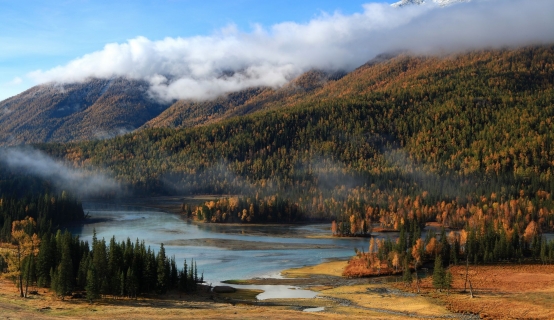 Go to Xinjiang in China
In Xinjiang you get to see a mix of East and Central Asia. An experience that you might want to add to your bucket list. You can travel through the province as if you are following an ancient silk route.
 Mount Kailash
The best time for a Kailash tour/trekking is from mid-May to mid-October when the temperature is most pleasant. It is warm, dry and sunny in that period.