

















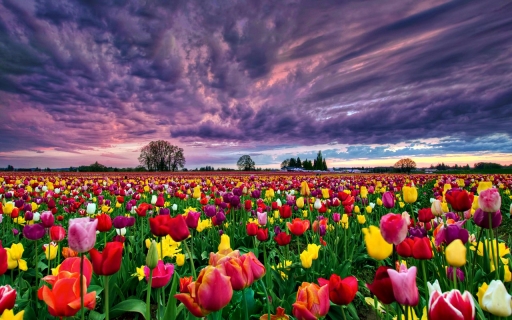
 Flower fields in the Netherlands
The flower fields in The Netherlands are world famous. The red, pink and yellow colors are breathtakingly beautiful and should be on the bucket list.
This page shows both the average monthly rainfall and the number of rainy days in Stiens, Friesland, Netherlands. These averages rely on historical data collected over 30 years, from 1990 to 2020. Let's now guide you through the details for a complete overview.
Generally, Stiens experiences moderate precipitation patterns, averaging 871 mm (34 in) yearly.
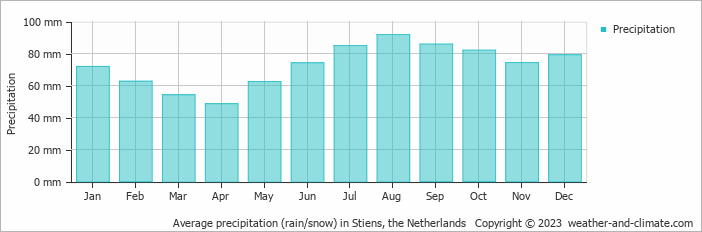
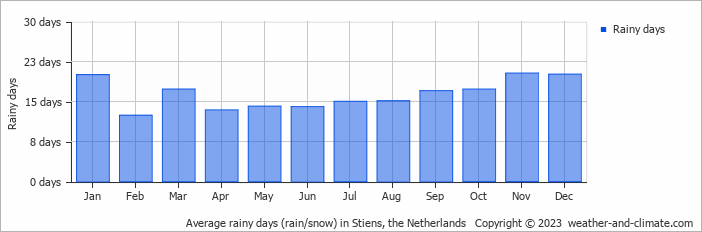
Stiens experiences moderate seasonal variation in rainfall, with monthly averages ranging from 92 mm (3.6 in) in August, the wettest month, and 49 mm (1.9 in) in April, the driest month.
August, the wettest month, has a maximum daytime temperature of 22°C (72°F). The city receives 207 hours of sunshine in this period. During the driest month April you can expect a temperature of 13°C (55°F). For more detailed insights into the city's temperatures, visit our Stiens Temperature page.
The map below shows the annual precipitation across the Netherlands. You can also select the different months in case you are interested in a specific month.
Stiens's average annual precipitation is 871 mm (34 in). Let's compare this to some popular worldwide tourist destinations:
Seville, Spain, experiences 541 mm (21 in) of rainfall annually, with wet winters and dry summers typical of southern Spain.
In Seoul, South Korea, the average annual precipitation is 1237 mm (49 in), with most rain falling during the summer monsoon season.
In Tokyo, Japan, the average annual precipitation is 1528 mm (60 in), with significant summer rains due to typhoon season.
Singapore, situated near the equator, gets 2581 mm (102 in) of rainfall annually, with no distinct dry season and consistent monthly precipitation.
Precipitation amounts are measured using specific gauges installed at weather stations, collecting both rain and snow and any other type of precipitation. Rainfall is measured directly in millimeters, while that from snow and ice is obtained by melting it. Automated systems often incorporate heaters to make this easier.
Information from these stations is transmitted via Wi-Fi, satellite, GPS, or telephone connections to central monitoring networks. This information is immediately updated and integrated into weather models and forecasts.
For more detailed information about Stiens's weather, including sunshine hours, humidity levels, and temperature data, visit our Stiens Climate page.
Pick a month to see the average temperature, rainfall and sunshine in Stiens - and find the best time to visit.
Temperature Rainfall Sunshine Humidity Wind Speed
See the full Stiens climate overview or explore weather in the Netherlands.
Where to go in October - average daytime high across popular destinations.
Noordwijk aan Zee 15°C (59°F) Valkenburg15°C (59°F) Utrecht15°C (59°F) Maastricht16°C (61°F) Rotterdam16°C (61°F) Zandvoort
 15°C (59°F) The Hague16°C (61°F) Amsterdam15°C (59°F)
 Need travel inspiration? Check out our bucket list articles and be inspired.
Flower fields in the Netherlands
The flower fields in The Netherlands are world famous. The red, pink and yellow colors are breathtakingly beautiful and should be on the bucket list.
 Pride in Amsterdam
Nowhere in the world is Pride being celebrated on the water on such a scale as in Amsterdam. It is an unique experience that every person needs to add to his, her or its bucket list.
 The greenest experience of Amsterdam
If you’re looking for an experience of Amsterdam that is rooted in nature, that can help you go outside and get your hands dirty, then these tips are for you.
 Amsterdam Dance Event
ADE is one of the larger festival giants, but you may never have heard of it if you are not an electronic music fan. It last five days and takes place in October.