
















 Warm Sea Without Extreme Heat: 8 Beach Destinations With Comfortable Weather
Love warm seawater but not extreme heat? Compare eight beach destinations where the sea stays warm while daytime temperatures remain comfortable.
This page shows both the average monthly rainfall and the number of rainy days in Sant Cugat del Vallès, Catalonia, Spain. These averages rely on historical data collected over 30 years, from 1990 to 2020. Now, let's explore all the details to give you a full picture.
On average, Sant Cugat del Vallès receives a reasonable amount of rainfall, with an annual precipitation of 665 mm (26 in).


Significant seasonal changes in precipitation occur throughout the year. During the wettest month, October receives substantial rainfall, averaging 96 mm (3.8 in) of precipitation, recorded across 11 rainy days.
In contrast, the driest month, July brings less rainfall, with 33 mm (1.3 in) over 6 rainy days.
October, the wettest month, has a maximum daytime temperature of 22°C (72°F). The city receives 178 hours of sunshine in this period. During the driest month July you can expect a temperature of 28°C (82°F). For more detailed insights into the city's temperatures, visit our Sant Cugat del Vallès Temperature page.
The map below shows the annual precipitation across Spain. You can also select the different months in case you are interested in a specific month.
Sant Cugat del Vallès's average annual precipitation is 665 mm (26 in). Let's compare this to some popular worldwide tourist destinations:
Boston, USA, experiences 1238 mm (49 in) of annual precipitation, including significant snowfall during the winter.
Meanwhile, Buenos Aires, Argentina, enjoys a humid subtropical climate with 1000 mm (39 in) of annual rainfall, mostly in the summer.
In Tokyo, Japan, the average annual precipitation is 1528 mm (60 in), with significant summer rains due to typhoon season.
Singapore, situated near the equator, gets 2581 mm (102 in) of rainfall annually, with no distinct dry season and consistent monthly precipitation.
Precipitation amounts are measured using specific gauges installed at weather stations, collecting both rain and snow and any other type of precipitation. Rainfall is measured directly in millimeters, while that from snow and ice is obtained by melting it. Automated systems often incorporate heaters to make this easier.
Information from these stations is transmitted via Wi-Fi, satellite, GPS, or telephone connections to central monitoring networks. This information is immediately updated and integrated into weather models and forecasts.
For more detailed information about Sant Cugat del Vallès's weather, including sunshine hours, humidity levels, and temperature data, visit our Sant Cugat del Vallès Climate page.
Pick a month to see the average temperature, rainfall and sunshine in Sant Cugat del Vallès - and find the best time to visit.
Temperature Rainfall Sunshine Humidity Wind Speed Water Temp
See the full Sant Cugat del Vallès climate overview or explore weather in Spain.
Where to go in October - average daytime high across popular destinations.
Need travel inspiration? Check out our bucket list articles and be inspired.
Warm Sea Without Extreme Heat: 8 Beach Destinations With Comfortable Weather
Love warm seawater but not extreme heat? Compare eight beach destinations where the sea stays warm while daytime temperatures remain comfortable.

 El Hierro: The smallest Canary island without mass tourism
Mainly nature lovers and those seeking tranquility go to El Hierro. The island is know for its beautiful mountains and you can wonder around for days here.
 Spain in October: Where Is It Warmest and Sunniest?
Discover where Spain is warmest in October, with climate comparisons for Seville, Alicante, Málaga, Tenerife, Madrid and Barcelona.
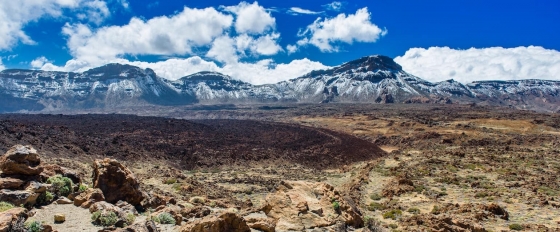 Visit national Park El Teide
This national park is truly a unique place that you should not miss. You will find landscapes that seem to come from another plane and you will feel tiny in these impressive surroundings.