San Mateo de Gállego Monthly Rainfall & Precipitation
This page shows both the average monthly rainfall and the number of rainy days in San Mateo de Gállego, Aragon, Spain. The figures are based on a 30-year period (1990–2020) to provide a reliable average. Now, let's break down all the details for a clearer picture.
San Mateo de Gállego tends toward drier weather patterns, receiving approximately 438 mm (17 in) of rain per year. The city experiences a distinct dry season during certain months, contributing to seasonal contrasts shown in the charts below.
Monthly Rainfall & Rainy Days
Monthly Precipitation Levels

The average number of days each month with precipitation (> 0.2 mm (0.01 in))
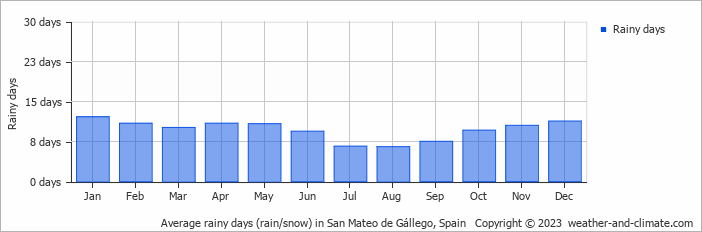
The climate in San Mateo de Gállego shows significant variation throughout the year. Expect 53 mm (2.1 in) of precipitation during the wettest month October, distributed over 10 rainy days.
In contrast, July offers drier and sunnier days, with around 19 mm (0.7 in) of rainfall over 7 rainy days.
October, the wettest month, has a maximum daytime temperature of 23°C (73°F). The city receives 196 hours of sunshine in this period. During the driest month July you can expect a temperature of 34°C (93°F). For more detailed insights into the city's temperatures, visit our San Mateo de Gállego Temperature page.
Annual Rainfall in Spain: City Comparison
The map below shows the annual precipitation across Spain. You can also select the different months in case you are interested in a specific month.
San Mateo de Gállego vs World: Rainfall Compared
San Mateo de Gállego's average annual precipitation is 438 mm (17 in). Let's compare this to some popular worldwide tourist destinations:
Athens, Greece, receives an average annual precipitation of 400 mm (16 in), making it one of the drier Mediterranean climates with rainfall mostly in winter.
Beijing, China, receives 560 mm (22 in) of annual precipitation, concentrated in the summer months.
In Tokyo, Japan, the average annual precipitation is 1528 mm (60 in), with significant summer rains due to typhoon season.
Mumbai, India, experiences a tropical monsoon climate with 1860 mm (73 in) of annual rainfall, with the majority of precipitation happening during the monsoon season from June to September.
Precipitation amounts are measured using specific gauges installed at weather stations, collecting both rain and snow and any other type of precipitation. Rainfall is measured directly in millimeters, while that from snow and ice is obtained by melting it. Automated systems often incorporate heaters to make this easier.
Information from these stations is transmitted via Wi-Fi, satellite, GPS, or telephone connections to central monitoring networks. This information is immediately updated and integrated into weather models and forecasts.
The proximity of a location to a large body of water can significantly affect its rainfall patterns:
- Ocean Influence: Coastal regions typically receive more rainfall due to the presence of moisture-laden winds from the ocean. These regions tend to have more humid climates and experience more frequent precipitation, especially in winter.
- Continental Climates: Areas further from the sea, such as inland or continental regions, experience less frequent rainfall and more extreme seasonal variations in precipitation.
- The U.S. has a significant number of thunderstorms every year, with over 14.6 million taking place across the world annually.
- Approximately 70% of lightning bolts strike land rather than oceans.
- A storm named John was the longest-lasting Pacific tropical storm, continuing for 31 days. As it crossed the dateline twice, it changed status from a hurricane to a typhoon and back to a hurricane.
For more detailed information about San Mateo de Gállego's weather, including sunshine hours, humidity levels, and temperature data, visit our San Mateo de Gállego Climate page.
San Mateo de Gállego Weather by Month
Pick a month to see the average temperature, rainfall and sunshine in San Mateo de Gállego - and find the best time to visit.




San Mateo de Gállego 3-Day Forecast
Temperature Rainfall Sunshine Humidity
See the full San Mateo de Gállego climate overview or explore weather in Spain.
Popular this month
Where to go in September - average daytime high across popular destinations.















Bucket list
Need travel inspiration? Check out our bucket list articles and be inspired.
 El Hierro: The smallest Canary island without mass tourism
Mainly nature lovers and those seeking tranquility go to El Hierro. The island is know for its beautiful mountains and you can wonder around for days here.
Spain in October: Where Is It Warmest and Sunniest?
Discover where Spain is warmest in October, with climate comparisons for Seville, Alicante, Málaga, Tenerife, Madrid and Barcelona.
Visit national Park El Teide
This national park is truly a unique place that you should not miss. You will find landscapes that seem to come from another plane and you will feel tiny in these impressive surroundings.
Sevilla: A Blend of Tradition, Culture, and Hidden Gems
Experience Sevilla in spring with Semana Santa processions and Feria de Abril festivities, set against the city's iconic landmarks and vibrant culture.