













 Where to Go for Christmas: Sun, Value and Fewer Crowds
Where can you find warm Christmas weather without peak-season prices and huge crowds? Compare Marsa Alam, The Gambia, Vietnam, Agadir and Cap Skirring.
This page shows both the average monthly rainfall and the number of rainy days in Ouoran, Senegal. The numbers reflect climate data gathered over a 30-year period, from 1990 to 2020. Now, let's explore all the details to give you a full picture.
Ouoran tends toward drier weather patterns, receiving approximately 403 mm (16 in) of rain per year. The city experiences a distinct dry season during certain months, contributing to seasonal contrasts shown in the charts below.
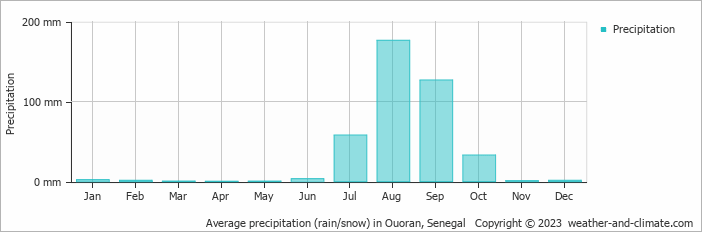
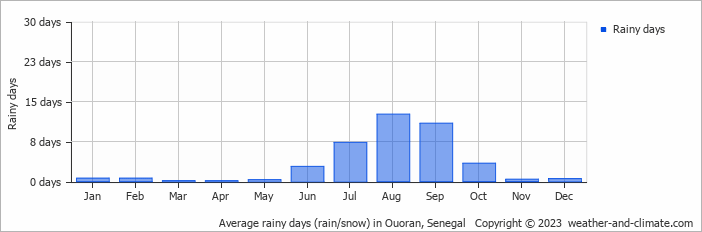
Ouoran can be quite wet during August, receiving approximately 176 mm (6.9 in) of precipitation over 13 rainy days.
In contrast April, experiences much drier conditions, with 0.1 mm (0 in) of rainfall, spread across 0 rainy days.
August, the wettest month, has a maximum daytime temperature of 30°C (86°F). The city receives 223 hours of sunshine in this period. During the driest month April you can expect a temperature of 30°C (86°F). For more detailed insights into the city's temperatures, visit our Ouoran Temperature page.
Average daily rainfall for each day of the month based on long-term records. 50-year average (1976-2025)
Browse day-by-day precipitation records for Ouoran spanning 51 years. Select any month and year to see actual rainfall and snowfall recorded on each day.
The map below shows the annual precipitation across Senegal. You can also select the different months in case you are interested in a specific month.
Ouoran's average annual precipitation is 403 mm (16 in). Let's compare this to some popular worldwide tourist destinations:
The city of Rome, Italy, has an average annual precipitation of 832 mm (33 in), spread fairly evenly throughout the year.
In Seoul, South Korea, the average annual precipitation is 1237 mm (49 in), with most rain falling during the summer monsoon season.
In Tokyo, Japan, the average annual precipitation is 1528 mm (60 in), with significant summer rains due to typhoon season.
Ho Chi Minh City, Vietnam, receives 1955 mm (77 in) of annual rainfall, with a pronounced wet season from May to November, typical of its tropical monsoon climate.
Precipitation amounts are measured using specific gauges installed at weather stations, collecting both rain and snow and any other type of precipitation. Rainfall is measured directly in millimeters, while that from snow and ice is obtained by melting it. Automated systems often incorporate heaters to make this easier.
Information from these stations is transmitted via Wi-Fi, satellite, GPS, or telephone connections to central monitoring networks. This information is immediately updated and integrated into weather models and forecasts.
Precipitation has a very strong role in determining the local climate and ecosystem:
For more detailed information about Ouoran's weather, including sunshine hours, humidity levels, and temperature data, visit our Ouoran Climate page.
Pick a month to see the average temperature, rainfall and sunshine in Ouoran - and find the best time to visit.
Temperature Rainfall Sunshine Humidity
See the full Ouoran climate overview or explore weather in Senegal.
Where to go in October - average daytime high across popular destinations.
 Saint-Louis
 33°C (91°F) Ndangane33°C (91°F) Somone
 32°C (90°F) Saly Portudal32°C (90°F) Mbour32°C (90°F) Niaga32°C (90°F) Cap Skirring
 31°C (88°F) Dakar30°C (86°F)
 Need travel inspiration? Check out our bucket list articles and be inspired.
Where to Go for Christmas: Sun, Value and Fewer Crowds
Where can you find warm Christmas weather without peak-season prices and huge crowds? Compare Marsa Alam, The Gambia, Vietnam, Agadir and Cap Skirring.
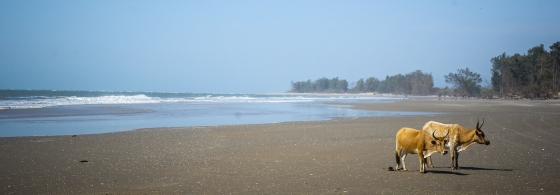 The Casamance, a green pearl with spectacular beaches
Casamance, in the south of Senegal, is without doubt one of the most beautiful destinations in the country. It is sometimes called the Bali of Africa.
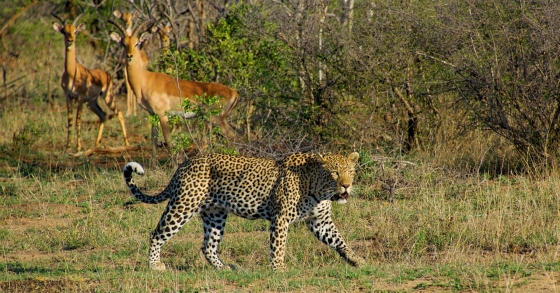
 Visit Kruger Park in South Africa
Are you going to South Africa, then you cannot skip the Kruger Park. The Kruger Park is one of the most beautiful and largest safari parks in the world.
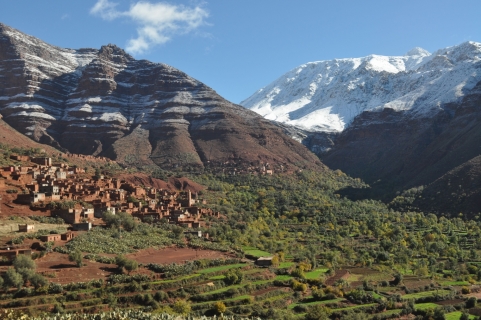
 The Atlas Mountains in Morocco
This mountain range is the second highest mountains in the world and is certainly one of the most natural and wonderful mountains you could ever visit. One for the bucket list for sure.