

















 Hike the Israel National Trail
If you consider hiking the entire trail, then the best time of year for the trek is February to May. The weather is pretty mild at this time of the year.
This page shows both the average monthly rainfall and the number of rainy days in Bet HaShitta, North District Israel, Israel. These averages rely on historical data collected over 30 years, from 1990 to 2020. Let's explore the details to provide you with a complete overview.
Bet HaShitta typically sees modest rainfall throughout the year, with an average annual precipitation of 394 mm (16 in). The city experiences a distinct dry season during certain months, as illustrated in the graph below.
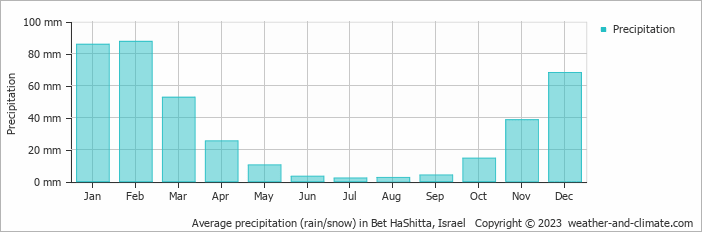
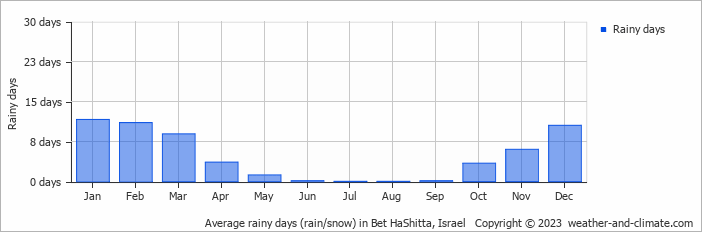
Bet HaShitta can be quite wet during February, receiving approximately 88 mm (3.5 in) of precipitation over 11 rainy days.
In contrast July, experiences much drier conditions, with 2.1 mm (0.1 in) of rainfall, spread across 0 rainy days.
February, the wettest month, has a maximum daytime temperature of 19°C (66°F). The city receives 175 hours of sunshine in this period. During the driest month July you can expect a temperature of 36°C (97°F). For more detailed insights into the city's temperatures, visit our Bet HaShitta Temperature page.
The map below shows the annual precipitation across Israel. You can also select the different months in case you are interested in a specific month.
Bet HaShitta's average annual precipitation is 394 mm (16 in). Let's compare this to some popular worldwide tourist destinations:
In Barcelona, Spain, the average annual precipitation is 620 mm (24 in), evenly distributed across the year with no extreme wet or dry seasons.
Beijing, China, receives 560 mm (22 in) of annual precipitation, concentrated in the summer months.
In Tokyo, Japan, the average annual precipitation is 1528 mm (60 in), with significant summer rains due to typhoon season.
Singapore, situated near the equator, gets 2581 mm (102 in) of rainfall annually, with no distinct dry season and consistent monthly precipitation.
Precipitation amounts are measured using specific gauges installed at weather stations, collecting both rain and snow and any other type of precipitation. Rainfall is measured directly in millimeters, while that from snow and ice is obtained by melting it. Automated systems often incorporate heaters to make this easier.
Information from these stations is transmitted via Wi-Fi, satellite, GPS, or telephone connections to central monitoring networks. This information is immediately updated and integrated into weather models and forecasts.
Precipitation has a very strong role in determining the local climate and ecosystem:
For more detailed information about Bet HaShitta's weather, including sunshine hours, humidity levels, and temperature data, visit our Bet HaShitta Climate page.
Pick a month to see the average temperature, rainfall and sunshine in Bet HaShitta - and find the best time to visit.
Temperature Rainfall Sunshine Humidity
See the full Bet HaShitta climate overview or explore weather in Israel.
Where to go in October - average daytime high across popular destinations.
Tiberias 31°C (88°F) Eilat31°C (88°F) Netanya29°C (84°F) Tel Aviv29°C (84°F) Jerusalem30°C (86°F) Herzelia29°C (84°F) Bat Yam28°C (82°F) Haifa28°C (82°F)
 Need travel inspiration? Check out our bucket list articles and be inspired.
Hike the Israel National Trail
If you consider hiking the entire trail, then the best time of year for the trek is February to May. The weather is pretty mild at this time of the year.
 Midburn: The Israeli version of Burning Man
Midburn is an amazing event held in a desert in southern Israel called Negev. Just like burning man, a temporary city is established in the middle of the desert every year.
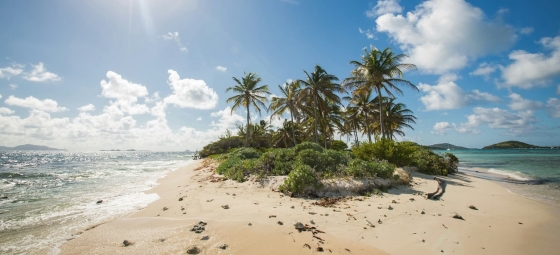
 10 Hidden gems in Asia you need to visit
Explore 10 hidden gems in Asia offering authentic experiences, from pristine beaches and remote islands to cultural treks and peaceful mountain villages.
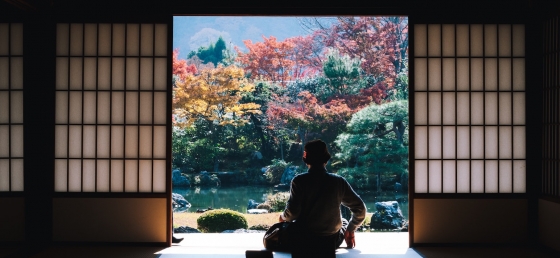
 Chase the autumn leaves in Japan
Japan is one of these cases which turns into a gold, yellow and orange fairy tale starting from September. And we can honestly say: We cannot imagine a more beautiful season to visit Japan.