Les Terres Basses Sunshine Hours by Month
Sunshine is key to understanding how a place experiences its seasons. This page shows the total number of hours of direct sunlight per month and the average hours per day in Les Terres Basses, Saint Martin. The numbers reflect climate data gathered over a 30-year period, from 1990 to 2020.
Monthly hours of sunshine
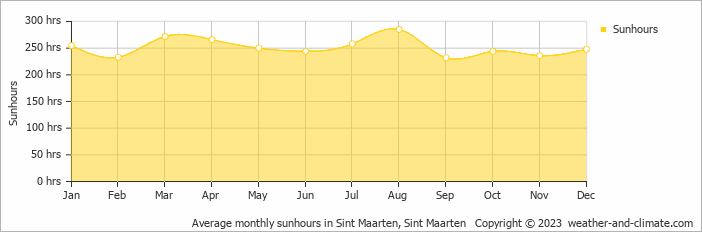
The sunniest days in Les Terres Basses occur in August, with around 285 hours of sunshine. Even in September, the least sunny month, Les Terres Basses still enjoys a comfortable 232 hours of sunlight. The total annual sunshine amounts to 3023 hours.
Daily hours of sunshine
Despite minor fluctuations, Les Terres Basses enjoys a fairly consistent amount of sunshine throughout the year. In August, you can expect approximately 9.5 hours of daily sunshine, while even in September, Les Terres Basses still receives about 7.7 hours.
Average percent of sunshine
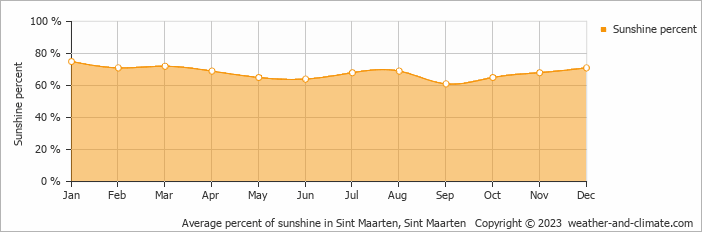
On average the sun shines 75% of the time during the day in January, the highest percentage of any month. September has the lowest percentage at 61%.
Les Terres Basses vs Major Cities: Sunshine Compared
Les Terres Basses enjoys an average of 3023 hours of sunshine annually. Let’s compare this with some popular tourist destinations:
Seville, Spain, enjoys an impressive 2920 hours of sunshine per year, making it an ideal destination even in winter.
In contrast, Reykjavík, Iceland, receives only about 1330 hours of sunshine per year, known for its frequently overcast and rainy skies.
The climate in San Francisco, USA, includes 3072 hours of sunshine annually, thanks to its mild coastal weather.
In Tokyo, Japan, the average annual sunshine is 1930 hours, with sunny periods between rainy seasons.
Related Climate Data for Les Terres Basses
October, Les Terres Basses’s wettest month, receives 97 mm (3.8 in) of rainfall and has a maximum daytime temperature of 29°C (84°F). During the driest month March you can expect a temperature of 27°C (81°F).
For more detailed insights into the city’s temperatures, check out our Temperature page. To explore more about precipitation patterns, visit our Les Terres Basses Precipitation page.
Les Terres Basses Weather by Month
Pick a month to see the average temperature, rainfall and sunshine in Les Terres Basses - and find the best time to visit.


Les Terres Basses 3-Day Forecast
Temperature Rainfall Sunshine Humidity Wind Speed Water Temp
See the full Les Terres Basses climate overview or explore weather in Saint Martin.
Popular this month
Where to go in September - average daytime high across popular destinations.
 Baie Longue
 30°C (86°F) Cul de Sac30°C (86°F) Marigot30°C (86°F) Grand Case30°C (86°F) Orient Bay French St Martin30°C (86°F) Les Terres Basses30°C (86°F) Baie Nettle30°C (86°F) Orient Bay30°C (86°F)













