
















 Warm Sea Without Extreme Heat: 8 Beach Destinations With Comfortable Weather
Love warm seawater but not extreme heat? Compare eight beach destinations where the sea stays warm while daytime temperatures remain comfortable.
Average temperatures, rainfall, sunshine and the best time to visit Isla de la Toja.
 –
10-day forecastForecast
Isla de la Toja, Galicia, Spain, experiences moderate temperature changes through the seasons. August is the warmest month with daytime highs of 24°C (75°F), while January is the coolest at 14°C (57°F).
The city has a wet climate, receiving around 1618 mm (64 in) of rainfall per year. Despite the high annual total, it has a distinct rainy season from October to January, with warm summers and mild winters. November is the wettest month. The sunniest month is July, with 10.4 hours of sunshine per day on average.
Pick a month to see the average temperature, rainfall and sunshine in Isla de la Toja - and find the best time to visit.
The weather in Isla de la Toja changes moderately throughout the year, offering enough variation to appreciate each season. On average, daytime temperatures range from a comfortable 24°C (75°F) in August to a moderate 14°C (57°F) in January.
Nighttime temperatures range from 16°C (61°F) in August to 8°C (46°F) in January.
Check out our detailed temperature page for more information.

Isla de la Toja has a relatively rainy climate with high precipitation levels, averaging 1618 mm (64 in) of rainfall annually. The seasons in Isla de la Toja bring significant changes in precipitation. The wettest month, November, receives heavy rainfall, with an average of 212 mm (8.3 in) of precipitation. This rainfall is distributed across 19 rainy days.
In contrast, the driest month, July, experiences much less rainfall, totaling 37 mm (1.5 in) over 8 rainy days. These distinct seasonal differences provide diverse experiences throughout the year. For more details, please visit our Isla de la Toja Precipitation page.


In Isla de la Toja, summer days are longer and more sunny, with daily sunshine hours peaking at 10.4 hours in July. As the darker season arrives, the brightness of the sun becomes less. December sees a soft sun for only 4.3 hours per average day.
Visit our detailed sunshine hours page for more information.

The relative humidity is high throughout the year in Isla de la Toja.
The city experiences its highest humidity in January, reaching 85%. In June, the humidity drops to its lowest level at 71%. What does this mean? Read our detailed page on humidity levels for further details.

Monthly ratings reflect general weather comfort, based on daytime temperature and rainfall. Swimming and winter conditions are highlighted separately where relevant.
June, July, August and September typically offer the most optimal weather in Isla de la Toja. In contrast, January, November and December tend to have less optimal conditions. Isla de la Toja has a distinct rainy season from October to January, with warm summers and mild winters.
Daytime highs range from 14°C (57°F) in January to 24°C (75°F) in August. Nighttime lows range from 8°C (46°F) to 16°C (61°F).
Annual rainfall is around 1618 mm (64 in). November is the wettest month with 212 mm (8.3 in), while July is the driest with 37 mm (1.5 in).
Isla de la Toja receives around 2,495 hours of sunshine per year. July is the sunniest month with 312 hours, while December is the cloudiest with just 129 hours. Overall, Isla de la Toja enjoys abundant sunshine.
Isla de la Toja is highlighted - select any city to see its climate.
Where to go in October - average daytime high across popular destinations.
Need travel inspiration? Check out our bucket list articles and be inspired.
Warm Sea Without Extreme Heat: 8 Beach Destinations With Comfortable Weather
Love warm seawater but not extreme heat? Compare eight beach destinations where the sea stays warm while daytime temperatures remain comfortable.

 El Hierro: The smallest Canary island without mass tourism
Mainly nature lovers and those seeking tranquility go to El Hierro. The island is know for its beautiful mountains and you can wonder around for days here.
 Spain in October: Where Is It Warmest and Sunniest?
Discover where Spain is warmest in October, with climate comparisons for Seville, Alicante, Málaga, Tenerife, Madrid and Barcelona.
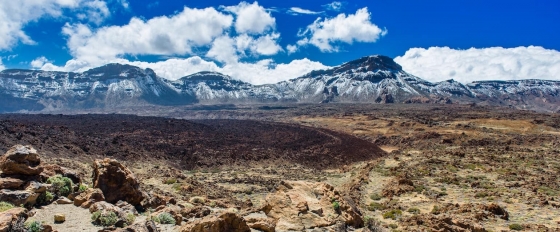 Visit national Park El Teide
This national park is truly a unique place that you should not miss. You will find landscapes that seem to come from another plane and you will feel tiny in these impressive surroundings.