














 Gorilla tracking in Uganda
Gorillas and people walk the same paths in Bwindi Impenetrable National Park in Uganda. It is a bucket list experience you will never forget.
Average temperatures, rainfall, sunshine and the best time to visit Iganga.
 –
Iganga, Uganda, enjoys a steady climate throughout the year, with daytime temperatures typically around 28°C (82°F). February is the warmest month at 30°C (86°F), while July is the coolest at 28°C (82°F).
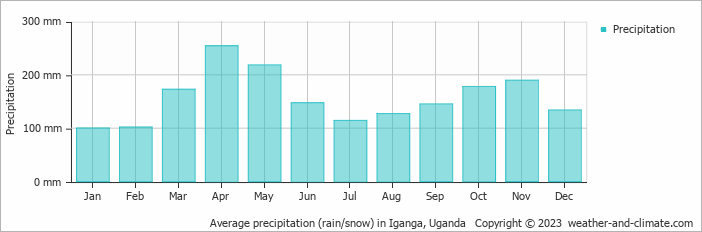
With around 1882 mm (74 in) of annual rainfall, Iganga has a notably wet climate. However, this rainfall is not evenly distributed, the city has a distinct rainy season from March to May. The wettest month is April.
Pick a month to see the average temperature, rainfall and sunshine in Iganga - and find the best time to visit.
The temperature in Iganga remains steady throughout the year, providing a consistently very warm climate. Average daytime temperatures reach a very warm 30°C (86°F) in February. In July, the coolest month of the year, temperatures drop to a comfortable 28°C (82°F).
At night, temperatures range from around 20°C (68°F) in February to 18°C (64°F) in July.
Check out our detailed temperature page for more information.

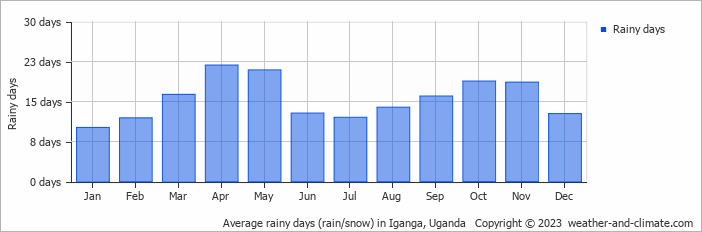
Iganga has a relatively rainy climate with high precipitation levels, averaging 1882 mm (74 in) of rainfall annually. Iganga can be quite wet during April, receiving approximately 254 mm (10 in) of precipitation over 22 rainy days.
In contrast, during the driest month (January), you will experience much drier conditions, with 100 mm (3.9 in) of precipitation spread across 10 rainy days. For more details, please visit our Iganga Precipitation page.
Monthly ratings reflect general weather comfort, based on daytime temperature and rainfall. Swimming and winter conditions are highlighted separately where relevant.
January, March, June, July, August, September, October and December typically offer the most optimal weather in Iganga. In contrast, February, April and May tend to have less optimal conditions. Iganga has a distinct rainy season from March to May.
Daytime highs range from 28°C (82°F) in July to 30°C (86°F) in February. Nighttime lows range from 18°C (64°F) to 20°C (68°F). Temperatures stay relatively stable year-round.
Annual rainfall is around 1882 mm (74 in). April is the wettest month with 254 mm (10 in), while January is the driest with 100 mm (3.9 in).
Iganga is highlighted - select any city to see its climate.
Where to go in October - average daytime high across popular destinations.
Gulu 30°C (86°F) Mbarara
 27°C (81°F) Jinja27°C (81°F) Masaka27°C (81°F) Kampala26°C (79°F) Lyamutundwe26°C (79°F) Entebbe26°C (79°F) Kabale24°C (75°F)
Need travel inspiration? Check out our bucket list articles and be inspired.
Gorilla tracking in Uganda
Gorillas and people walk the same paths in Bwindi Impenetrable National Park in Uganda. It is a bucket list experience you will never forget.
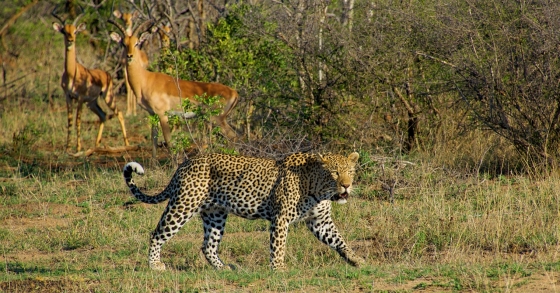
 Visit Kruger Park in South Africa
Are you going to South Africa, then you cannot skip the Kruger Park. The Kruger Park is one of the most beautiful and largest safari parks in the world.
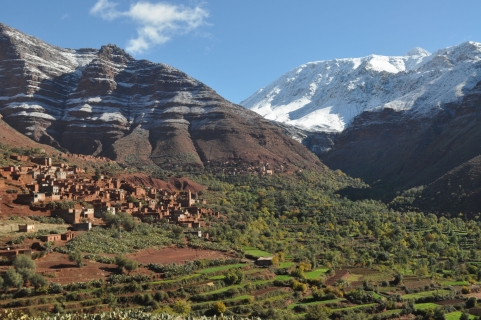
 The Atlas Mountains in Morocco
This mountain range is the second highest mountains in the world and is certainly one of the most natural and wonderful mountains you could ever visit. One for the bucket list for sure.
 One of South Africa's most spectacular private game reserves
Sabi Sand Game Reserve is one of South Africa's most spectacular private game reserves. The chance that you see the entire Big Five is high in winter (June - August).