
















 Warm Sea Without Extreme Heat: 8 Beach Destinations With Comfortable Weather
Love warm seawater but not extreme heat? Compare eight beach destinations where the sea stays warm while daytime temperatures remain comfortable.
Average temperatures, rainfall, sunshine and the best time to visit Haro.
 –
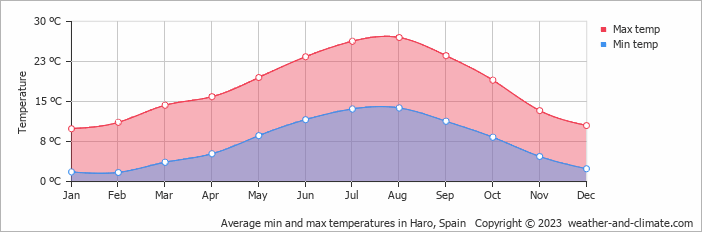
Haro, La Rioja, Spain, experiences significant temperature variation throughout the year. Summers bring daytime highs of 27°C (81°F) in August, while winters cool to 10°C (50°F) in January.
Annual rain/snowfall is moderate at around 783 mm (31 in), with April being the wettest month. The city also has warm summers and cold winters. Sunshine peaks in July, when the city sees around 10.7 hours of sunshine per day.
Pick a month to see the average temperature, rainfall and sunshine in Haro - and find the best time to visit.
Depending on the time of the year, temperatures range from comfortable to chilly in Haro. Average daytime temperatures reach a comfortable 27°C (81°F) in August. In January, the coolest month of the year, temperatures drop to a chilly 10°C (50°F).
At night, temperatures range from around 14°C (57°F) in August to 2°C (36°F) in January.
Check out our detailed temperature page for more information.
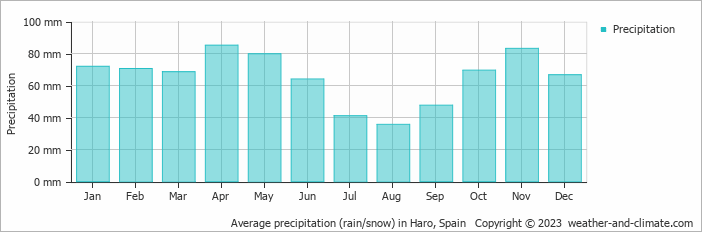
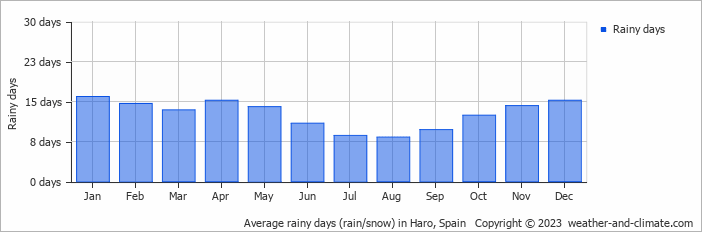
Generally, Haro has a moderate amount of precipitation, averaging 783 mm (31 in) of rain/snowfall annually. Haro can be quite wet during April, receiving approximately 85 mm (3.3 in) of precipitation over 15 rainy days.
In contrast, during the driest month (August), you will experience much drier conditions, with 36 mm (1.4 in) of precipitation spread across 8 rainy days. For more details, please visit our Haro Precipitation page.
Haro can be enjoyed more throughout the sunniest month of July under a blue sky, with approximately 10.7 hours of sunshine daily. In contrast, the city experiences much darker days in December, with only 2.7 hours of sunlight per day.
Visit our detailed sunshine hours page for more information.

Monthly ratings reflect general weather comfort, based on daytime temperature and rainfall. Swimming and winter conditions are highlighted separately where relevant.
May, June, July, August and September typically offer the most optimal weather in Haro. In contrast, January tends to have less optimal conditions. Haro has warm summers and cold winters.
Daytime highs range from 10°C (50°F) in January to 27°C (81°F) in August. Nighttime lows range from 2°C (36°F) to 14°C (57°F). Temperatures vary considerably through the year.
Annual rainfall is around 783 mm (31 in). April is the wettest month with 85 mm (3.3 in), while August is the driest with 36 mm (1.4 in).
Haro receives around 2,237 hours of sunshine per year. July is the sunniest month with 320 hours, while December is the cloudiest with just 80 hours. Overall, Haro enjoys abundant sunshine.
Haro is highlighted - select any city to see its climate.
Where to go in October - average daytime high across popular destinations.
Need travel inspiration? Check out our bucket list articles and be inspired.
Warm Sea Without Extreme Heat: 8 Beach Destinations With Comfortable Weather
Love warm seawater but not extreme heat? Compare eight beach destinations where the sea stays warm while daytime temperatures remain comfortable.

 El Hierro: The smallest Canary island without mass tourism
Mainly nature lovers and those seeking tranquility go to El Hierro. The island is know for its beautiful mountains and you can wonder around for days here.
 Spain in October: Where Is It Warmest and Sunniest?
Discover where Spain is warmest in October, with climate comparisons for Seville, Alicante, Málaga, Tenerife, Madrid and Barcelona.
 Visit national Park El Teide
This national park is truly a unique place that you should not miss. You will find landscapes that seem to come from another plane and you will feel tiny in these impressive surroundings.