














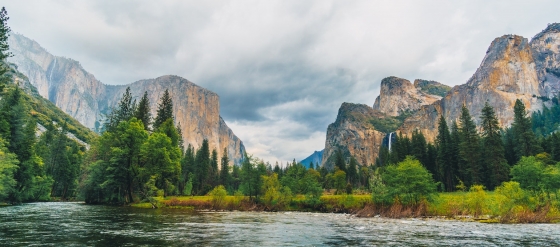
 Yosemite National Park is definitely worth a visit
Vast forests, blue lakes, towering sequoias, and majestic waterfalls hint at the beauty of Yosemite National Park—a true natural masterpiece.
Average temperatures, rainfall, sunshine and the best time to visit Austin.
 –
10-day forecastForecast
Pick a month to see the average temperature, rainfall and sunshine in Austin - and find the best time to visit.
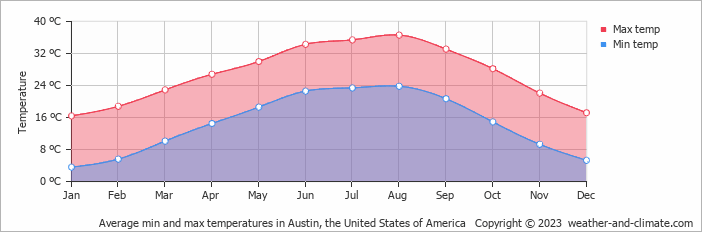
Depending on the time of the year, temperatures range from very hot to moderate in Austin. Average maximum daytime temperatures range from a very hot 37°C (99°F) in August, the warmest time of the year, to a moderate 16°C (61°F) during cooler months like January.
At night, you can expect temperatures ranging from 24°C (75°F) in August to around 4°C (39°F) during January.
Check out our detailed temperature page for more information.
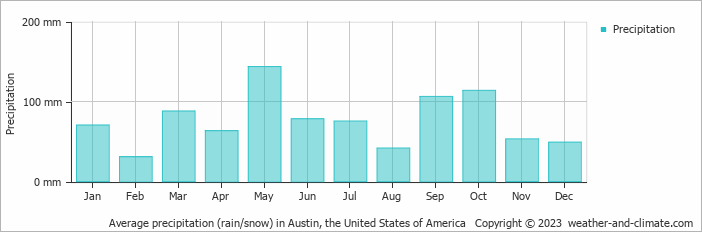
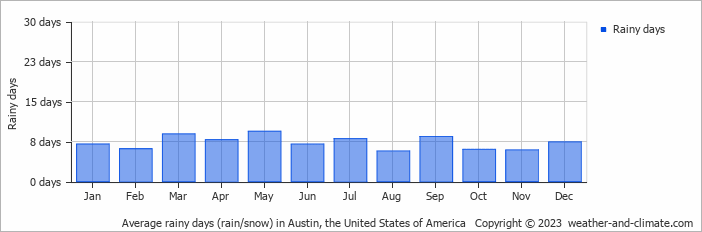
Generally, Austin has a moderate amount of precipitation, averaging 913 mm (36 in) of rainfall annually. Significant seasonal changes in precipitation occur throughout the year. In the wettest month, May it receives high rainfall, averaging 143 mm (5.6 in) of precipitation, recorded across 9 rainy days. In contrast, the driest month February brings less rainfall, with 31 mm (1.2 in) over 6 rainy days. For more details, please visit our Austin Precipitation page.
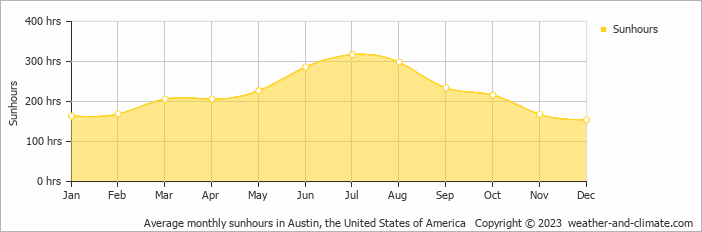
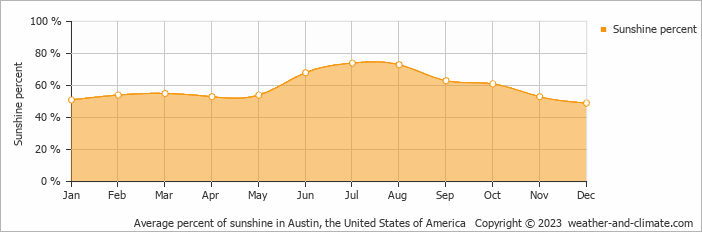
Seasonal changes in sunshine hours are quite dramatic in Austin. While July receives considerable daily sunshine with up to 10.6 hours, December marks the darkest time of the year, where sunshine is scarce with only 5.1 hours of sunlight per day.
Visit our detailed sunshine hours page for more information.
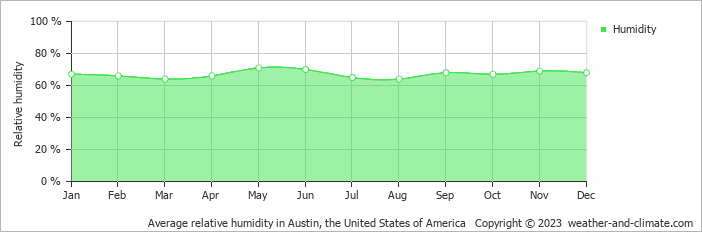
The relative humidity is high throughout the year in Austin.
The city experiences its highest humidity in May, reaching 71%. In March, the humidity drops to its lowest level at 64%. What does this mean? Read our detailed page on humidity levels for further details.
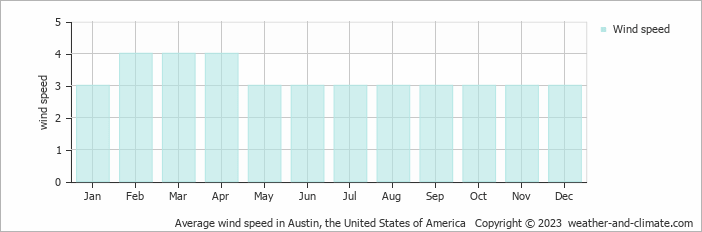
The average wind speed over the year ranges from 3 m/s (6 knots) to 4 m/s (8 knots). It is lower in January, May, June, July, August, September, October, November and December and higher in February, March and April. What does this mean?
Monthly ratings reflect general weather comfort, based on daytime temperature and rainfall. Swimming and winter conditions are highlighted separately where relevant.
March, April and November typically offer the most optimal weather in Austin. In contrast, June, July, August and September tend to have less optimal conditions. Austin has very hot summers and mild winters.
Daytime highs range from 16°C (61°F) in January to 37°C (99°F) in August. Nighttime lows range from 4°C (39°F) to 24°C (75°F). Temperatures vary considerably through the year.
Annual rainfall is around 913 mm (36 in). May is the wettest month with 143 mm (5.6 in), while February is the driest with 31 mm (1.2 in).
Austin receives around 2,645 hours of sunshine per year. July is the sunniest month with 317 hours, while December is the cloudiest with just 154 hours. Overall, Austin enjoys abundant sunshine.
Austin is highlighted - select any city to see its climate.
Where to go in November - average daytime high across popular destinations.
Miami Beach 27°C (81°F) Orlando25°C (77°F) Kissimmee26°C (79°F) Destin21°C (70°F) Los Angeles22°C (72°F) Big Bear Lake14°C (57°F) New York City
 13°C (55°F)
Not sure yet where to go? See where to go in North America, month by month, in our weather planner.
Need travel inspiration? Check out our bucket list articles and be inspired.
Yosemite National Park is definitely worth a visit
Vast forests, blue lakes, towering sequoias, and majestic waterfalls hint at the beauty of Yosemite National Park—a true natural masterpiece.
 The 10 most alternative cities in the United States
Discover the top 10 fun and alternative U.S. cities rich in art, culture, and adventure. From Portland's hippy charm to Sedona's stunning landscapes.
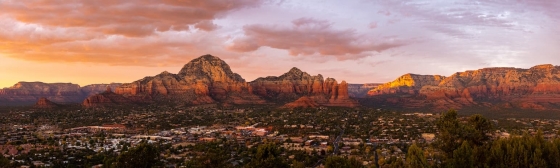 Sedona: Explore Majestic Red Rock Landscapes
A picturesque artists' town surrounded by red rocks and known for its spirituality, vortex energy, and stunning hikes like Cathedral Rock.
 10 most idyllic villages to visit in the United States
Discover 10 idyllic villages in the USA, from California to Vermont. Explore their unique charm, rich history, stunning nature, and vibrant arts scenes.