


















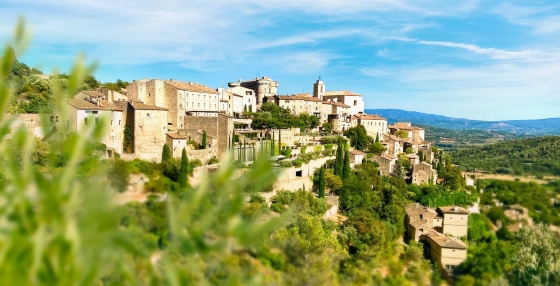
 The 10 most charming villages in France
Discover France's top 10 beautiful villages. From Normandy to the Côte d'Azur, experience quaint squares and cobbled streets. Which one will you visit this summer?
This page shows both the average monthly rainfall and the number of rainy days in Le Pic, France. These averages rely on historical data collected over 30 years, from 1990 to 2020. Let's now guide you through the details for a complete overview.
Generally, Le Pic receives mid-range precipitation levels, with 838 mm (33 in) annually.
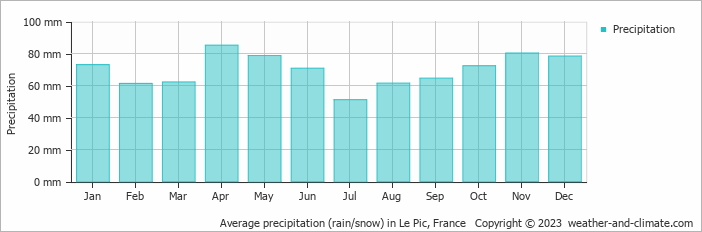
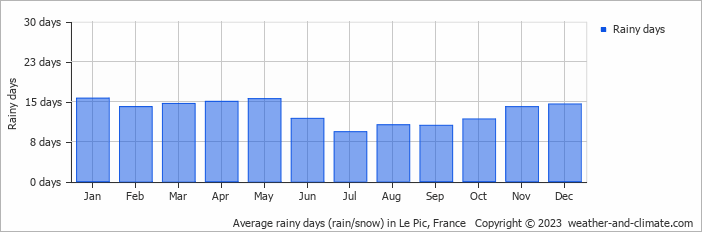
Le Pic experiences moderate seasonal variation in rainfall, with monthly averages ranging from 85 mm (3.3 in) in April, the wettest month, and 51 mm (2 in) in July, the driest month.
April, the wettest month, has a maximum daytime temperature of 19°C (66°F). The city receives 190 hours of sunshine in this period. During the driest month July you can expect a temperature of 29°C (84°F). For more detailed insights into the city's temperatures, visit our Le Pic Temperature page.
The map below shows the annual precipitation across France. You can also select the different months in case you are interested in a specific month.
Le Pic's average annual precipitation is 838 mm (33 in). Let's compare this to some popular worldwide tourist destinations:
In Barcelona, Spain, the average annual precipitation is 620 mm (24 in), evenly distributed across the year with no extreme wet or dry seasons.
Osaka, Japan, experiences 1507 mm (59 in) of rainfall annually, spread across the year with wetter summers.
In Brisbane, Australia, the annual precipitation is 979 mm (39 in), making it wetter than Sydney.
Mumbai, India, experiences a tropical monsoon climate with 1860 mm (73 in) of annual rainfall, with the majority of precipitation happening during the monsoon season from June to September.
Precipitation amounts are measured using specific gauges installed at weather stations, collecting both rain and snow and any other type of precipitation. Rainfall is measured directly in millimeters, while that from snow and ice is obtained by melting it. Automated systems often incorporate heaters to make this easier.
Information from these stations is transmitted via Wi-Fi, satellite, GPS, or telephone connections to central monitoring networks. This information is immediately updated and integrated into weather models and forecasts.
Climate change is affecting precipitation patterns worldwide, including Le Pic:
For more detailed information about Le Pic's weather, including sunshine hours, humidity levels, and temperature data, visit our Le Pic Climate page.
Pick a month to see the average temperature, rainfall and sunshine in Le Pic - and find the best time to visit.
Temperature Rainfall Sunshine
See the full Le Pic climate overview or explore weather in France.
Where to go in September - average daytime high across popular destinations.
Need travel inspiration? Check out our bucket list articles and be inspired.
The 10 most charming villages in France
Discover France's top 10 beautiful villages. From Normandy to the Côte d'Azur, experience quaint squares and cobbled streets. Which one will you visit this summer?
 An alternative way to discover Paris
From street art, vintage shops, vegetarian cafes, to amazing cultural events, Paris has much to offer for the creative traveler. An overview of sights that you must see if you want to visit this city in an alternative way.
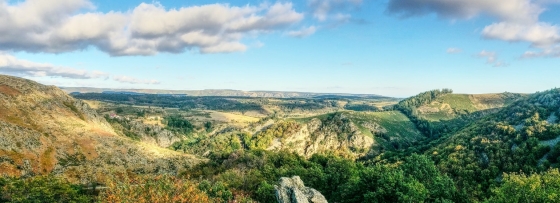 Nature is allowed to take its course in the Ardeche
The Ardèche is France at its most beautiful. The authentic villages and breathtaking mountainous landscapes are one of the main reasons. he climate in Ardèche is very pleasant. Temperatures are high during summer and it is often very sunny.

 Explore the natural wonders of Corsica
Corsica offers an abundance of incredible natural wonders to explore. This stunning Mediterranean island is a paradise for outdoor enthusiasts and nature lovers alike.