














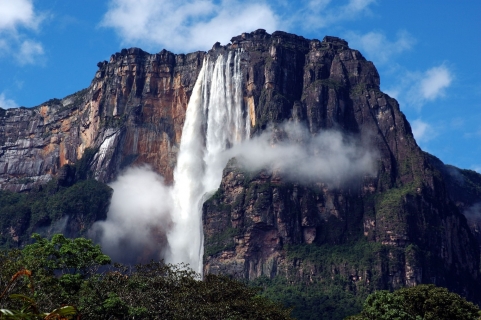
 Visit Angel Falls
There are many Waterfalls in South Amerika to visit, however The Angel Falls is a waterfall like no other. This world heritage park needs to undoubtedly be on your bucket list.
This page shows both the average monthly rainfall and the number of rainy days in Cuidad Bolivar, Venezuela. The numbers reflect climate data gathered over a 30-year period, from 1990 to 2020. Let's explore the details to provide you with a complete overview.
Cuidad Bolivar has a relatively rainy climate with high precipitation levels, averaging 1205 mm (47 in) of rainfall annually. Despite the high annual total, it does experience a distinct dry and rainy season during certain months. Examine our detailed charts below to understand these seasonal patterns.
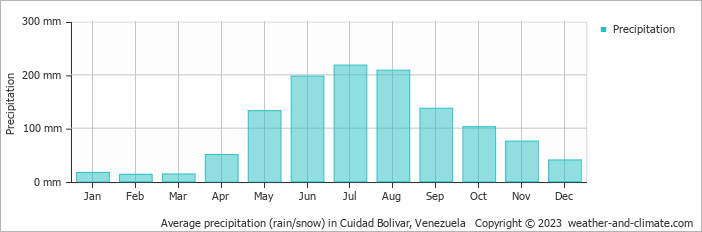
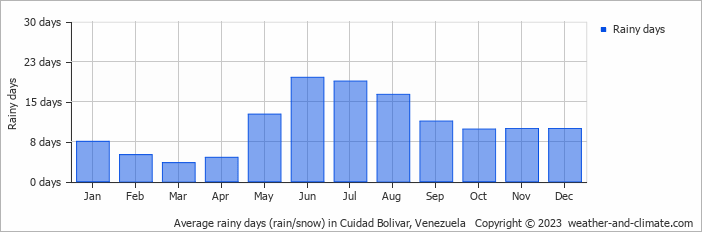
Significant seasonal changes in precipitation occur throughout the year. During the wettest month, July receives substantial rainfall, averaging 218 mm (8.6 in) of precipitation, recorded across 19 rainy days.
In contrast, the driest month, February brings less rainfall, with 13 mm (0.5 in) over 5 rainy days.
July, the wettest month, has a maximum daytime temperature of 32°C (90°F). The city receives 235 hours of sunshine in this period. During the driest month February you can expect a temperature of 35°C (95°F). For more detailed insights into the city's temperatures, visit our Cuidad Bolivar Temperature page.
Browse day-by-day precipitation records for Cuidad Bolivar spanning 51 years. Select any month and year to see actual rainfall and snowfall recorded on each day.
The map below shows the annual precipitation across Venezuela. You can also select the different months in case you are interested in a specific month.
Cuidad Bolivar's average annual precipitation is 1205 mm (47 in). Let's compare this to some popular worldwide tourist destinations:
Athens, Greece, receives an average annual precipitation of 400 mm (16 in), making it one of the drier Mediterranean climates with rainfall mostly in winter.
In Shanghai, China, the annual average precipitation is 1347 mm (53 in), with a humid subtropical climate.
Adelaide, Australia, enjoys 511 mm (20 in) of annual precipitation, with dry summers and wet winters.
Kuala Lumpur, Malaysia, receives 2529 mm (100 in) of annual rainfall, characteristic of its equatorial tropical rainforest climate, with consistent rainfall throughout the year and peak months during March and November.
Precipitation amounts are measured using specific gauges installed at weather stations, collecting both rain and snow and any other type of precipitation. Rainfall is measured directly in millimeters, while that from snow and ice is obtained by melting it. Automated systems often incorporate heaters to make this easier.
Information from these stations is transmitted via Wi-Fi, satellite, GPS, or telephone connections to central monitoring networks. This information is immediately updated and integrated into weather models and forecasts.
Precipitation has a very strong role in determining the local climate and ecosystem:
For more detailed information about Cuidad Bolivar's weather, including sunshine hours, humidity levels, and temperature data, visit our Cuidad Bolivar Climate page.
Pick a month to see the average temperature, rainfall and sunshine in Cuidad Bolivar - and find the best time to visit.
Temperature Rainfall Sunshine Humidity Wind Speed
See the full Cuidad Bolivar climate overview or explore weather in Venezuela.
Where to go in September - average daytime high across popular destinations.
Coro 34°C (93°F) Cuidad Bolivar
 34°C (93°F) Guanare
 33°C (91°F) Guasdualito32°C (90°F) Caraballeda30°C (86°F) Barquisimeto
 31°C (88°F) Caracas31°C (88°F) Isla De Aves30°C (86°F)
 Need travel inspiration? Check out our bucket list articles and be inspired.
Visit Angel Falls
There are many Waterfalls in South Amerika to visit, however The Angel Falls is a waterfall like no other. This world heritage park needs to undoubtedly be on your bucket list.
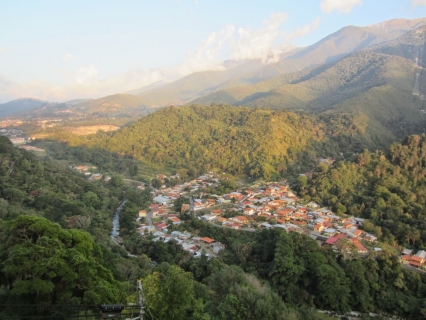 Go to Merida in Venezuela
Mérida is a laidback backpacker city and is full of students. The university city is the cultural center of the Andes and with a special location at 1700 meters a must for every traveler.

 Mount Roraima is one of the most spectacular treks in Latin America
Mount Roraima, the feeling is indescribable. This is where the world seems to stop. As if you are on the roof of the world. Something you need to add to the bucket list.

 Visit the Rainbow Mountains
The Rainbow Mountain (Vinicunca) is acolored rainbow mountain that will steal your heart forever and the view from the top will take your breath away.