

Leyburn Monthly Rainfall & Precipitation
This page shows both the average monthly rainfall and the number of rainy days in Leyburn, North Yorkshire, United Kingdom. These averages rely on historical data collected over 30 years, from 1990 to 2020. Now, let's break down all the details for a clearer picture.
Generally, Leyburn has a moderate amount of precipitation, averaging 969 mm (38 in) of rain/snowfall annually.
Monthly Precipitation Levels

The average number of days each month with precipitation (> 0.2 mm (0.01 in))
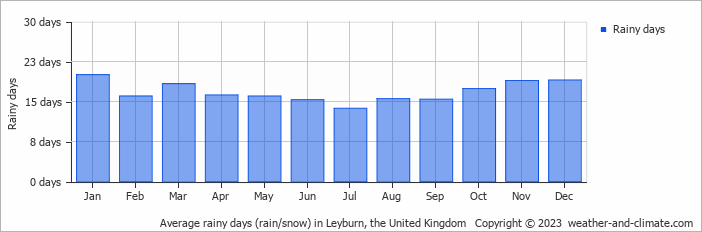
Despite minor fluctuations, Leyburn enjoys fairly consistent precipitation throughout the year. In December, you can expect around 91 mm (3.6 in) of precipitation, while in May, Leyburn receives about 69 mm (2.7 in).
December, the wettest month, has a maximum daytime temperature of 7°C (45°F). The city receives 52 hours of sunshine in this period. During the driest month May you can expect a temperature of 15°C (59°F). For more detailed insights into the city's temperatures, visit our Leyburn Temperature page.
Annual Rainfall in the United Kingdom: City Comparison
The map below shows the annual precipitation across the United Kingdom. You can also select the different months in case you are interested in a specific month.
 heavy rainfall
 high
high
 moderate
 low
low
 almost none
Leyburn vs World: Rainfall Compared
Leyburn's average annual precipitation is 969 mm (38 in). Let's compare this to some popular worldwide tourist destinations:
Boston, USA, experiences 1238 mm (49 in) of annual precipitation, including significant snowfall during the winter.
Beijing, China, receives 560 mm (22 in) of annual precipitation, concentrated in the summer months.
Melbourne, Australia, has 690 mm (27 in) of rainfall annually, spread fairly evenly throughout the year.
Bangkok, Thailand, experiences a tropical monsoon climate with 1668 mm (66 in) of annual rainfall, with the heaviest precipitation occurring during September and October.
Precipitation amounts are measured using specific gauges installed at weather stations, collecting both rain and snow and any other type of precipitation. Rainfall is measured directly in millimeters, while that from snow and ice is obtained by melting it. Automated systems often incorporate heaters to make this easier.
Information from these stations is transmitted via Wi-Fi, satellite, GPS, or telephone connections to central monitoring networks. This information is immediately updated and integrated into weather models and forecasts.
The proximity of a location to a large body of water can significantly affect its rainfall patterns:
- Ocean Influence: Coastal regions typically receive more rainfall due to the presence of moisture-laden winds from the ocean. These regions tend to have more humid climates and experience more frequent precipitation, especially in winter.
- Continental Climates: Areas further from the sea, such as inland or continental regions, experience less frequent rainfall and more extreme seasonal variations in precipitation.
- "Ginger" was the longest-lasting Atlantic tropical storm, which spun around the open ocean for 28 days in 1971.
- The world's largest snowflake was recorded in the Guinness Book of Records, at 38 cm (15 inches) wide and 20 cm (7.9 inches) thick. The snowflake fell at Fort Keogh, Montana, USA, on 28 January 1887.
- The greatest snowfall recorded was on Mt. Rainier, Washington State, USA—over 31.5 meters (103 feet) fell during the winter of 1972.
For more detailed information about Leyburn's weather, including sunshine hours, humidity levels, and temperature data, visit our Leyburn Climate page.