
















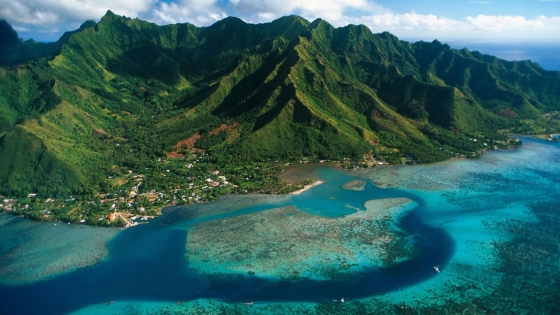
 Explore Tonga
Tonga is the first country of the international date limit. Being the first to start the new day on a peace of paradise is something you might want to add to your bucket list.
Average temperatures, rainfall, sunshine and the best time to visit Nuku‘alofa.
 –
10-day forecastForecast
–
10-day forecastForecast
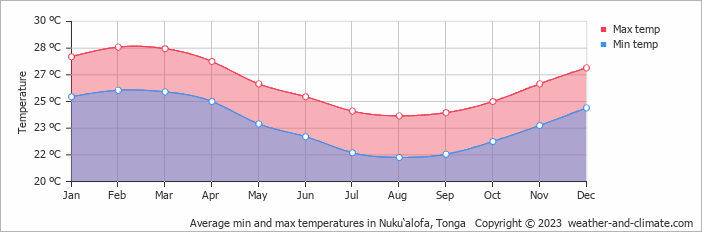
With consistently stable weather, Nuku‘alofa, Tongatapu Island, Tonga, sees little seasonal temperature change. Daytime highs average 26°C (79°F), ranging from 28°C (82°F) in February to 24°C (75°F) in August.
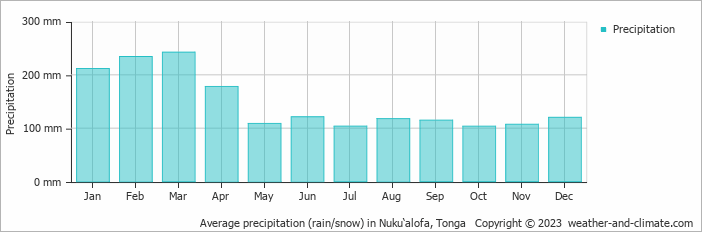
Rainfall is high, totalling around 1761 mm (69 in) per year. March is the wettest month and October the driest. The city also experiences a distinct rainy season from January to April.
Pick a month to see the average temperature, rainfall and sunshine in Nuku‘alofa - and find the best time to visit.
The climate in Nuku‘alofa remains fairly constant, offering comfortable temperatures throughout the year. Average maximum daytime temperatures range from a comfortable 28°C (82°F) in February, the warmest time of the year, to a comfortable 24°C (75°F) during cooler months like August.
At night, you can expect temperatures ranging from 26°C (79°F) in February to around 22°C (72°F) during August.
Check out our detailed temperature page for more information.
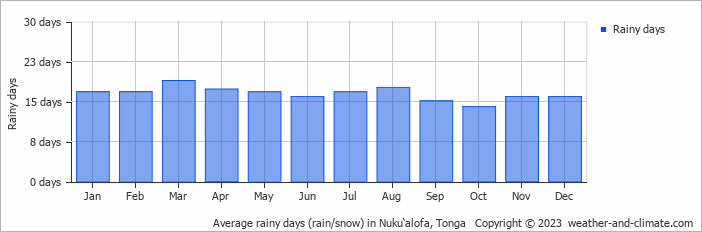
Nuku‘alofa is known for its substantial rainfall, with annual precipitation reaching 1761 mm (69 in). Significant seasonal changes in precipitation occur throughout the year. In the wettest month, March it receives heavy rainfall, averaging 242 mm (9.5 in) of precipitation, recorded across 19 rainy days. In contrast, the driest month October brings less rainfall, with 103 mm (4.1 in) over 14 rainy days. For more details, please visit our Nuku‘alofa Precipitation page.
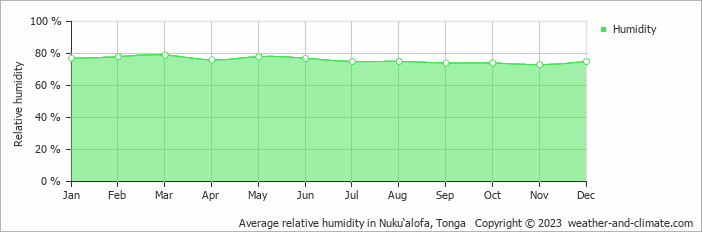
The relative humidity is high throughout the year in Nuku‘alofa.
The city experiences its highest humidity in March, reaching 79%. In November, the humidity drops to its lowest level at 73%. What does this mean? Read our detailed page on humidity levels for further details.
Monthly ratings reflect general weather comfort, based on daytime temperature and rainfall. Swimming and winter conditions are highlighted separately where relevant.
April, May, June, July, August, September, October, November and December typically offer the most optimal weather in Nuku‘alofa. In contrast, January, February and March tend to have less optimal conditions. Nuku‘alofa has a distinct rainy season from January to April.
Daytime highs range from 24°C (75°F) in August to 28°C (82°F) in February. Nighttime lows range from 22°C (72°F) to 26°C (79°F). Temperatures stay relatively stable year-round.
Annual rainfall is around 1761 mm (69 in). March is the wettest month with 242 mm (9.5 in), while October is the driest with 103 mm (4.1 in).
Nuku‘alofa is highlighted - select any city to see its climate.
Where to go in October - average daytime high across popular destinations.
Utungake 27°C (81°F) Neiafu27°C (81°F) Toula27°C (81°F) Uoleva Island26°C (79°F) Lotofoa26°C (79°F) Nuku‘alofa25°C (77°F) Kanokupolu25°C (77°F)
 Need travel inspiration? Check out our bucket list articles and be inspired.
Explore Tonga
Tonga is the first country of the international date limit. Being the first to start the new day on a peace of paradise is something you might want to add to your bucket list.

 An alternative way to discover Sydney
We have made an overview of the sights in Sydney that you must see if you want to visit Sydney in an alternative way.
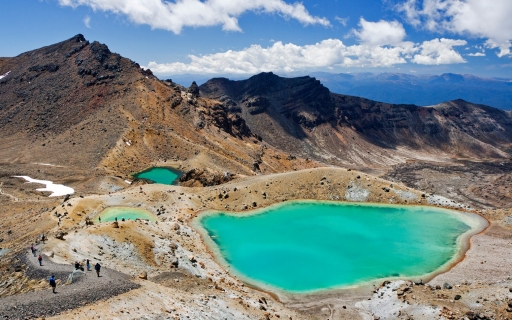
 The Tongariro Crossing in New Zealand
It is called the most beautiful walk in New Zealand, the Tongariro Crossing. The official hiking season starts late October until end of April.
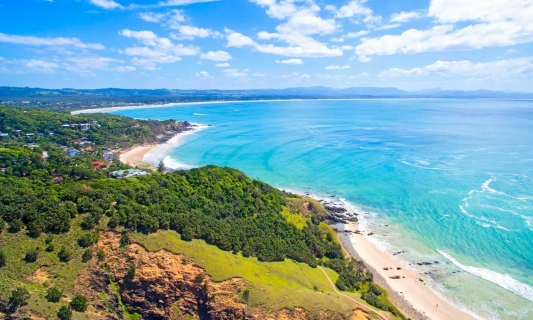 The most relaxed and alternative area of Australia is called the Byron Shire
The Byron Shire is one of the most pretty areas in the world. Not only in terms on natural beauty, also the relaxed vibe and people make this an area that remains close to your heart.