Lagos Weather & Climate: Best Time to Visit
Average temperatures, rainfall, sunshine and the best time to visit Lagos.
Climate overview of Lagos
The climate in Lagos, Nigeria, is remarkably consistent, with temperatures year-round averaging 30°C (86°F). The warmest month is February at 31°C (88°F), and the coolest is August at 28°C (82°F).
The city has a wet climate, receiving around 1729 mm (68 in) of rainfall per year. Despite the high annual total, it has a distinct rainy season from May to July. June is the wettest month. Sunshine peaks in December, when the city sees around 6.4 hours of sunshine per day.
Lagos Weather by Month
Pick a month to see the average temperature, rainfall and sunshine in Lagos — and find the best time to visit.
Monthly Temperature in Lagos
In Lagos temperatures are generally consistent throughout the year. On average, daytime temperatures range from a very warm 31°C (88°F) in February to a comfortable 28°C (82°F) in August.
Nighttime temperatures range from 27°C (81°F) in February to 24°C (75°F) in August.
Check out our detailed temperature page for more information.
Temperature ranges by month
Rainfall in Lagos
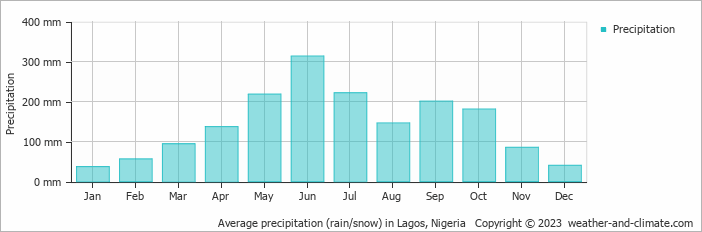
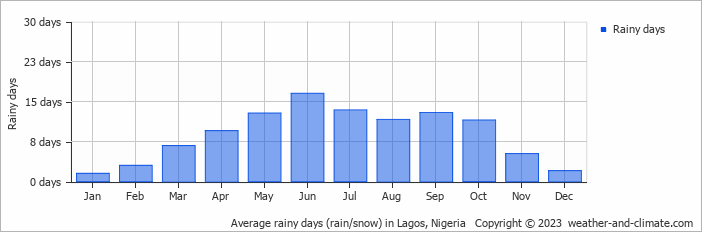
Lagos experiences significant rainfall throughout the year, averaging 1729 mm (68 in) of precipitation annually. The seasons in Lagos bring significant changes in precipitation. The wettest month, June, receives heavy rainfall, with an average of 313 mm (12 in) of precipitation. This rainfall is distributed across 17 rainy days.
In contrast, the driest month, January, experiences much less rainfall, totaling 37 mm (1.5 in) over 2 rainy days. These distinct seasonal differences provide diverse experiences throughout the year. For more details, please visit our Lagos Precipitation page.
The mean monthly precipitation over the year, including rain, hail, and snow

Sunshine Hours in Lagos
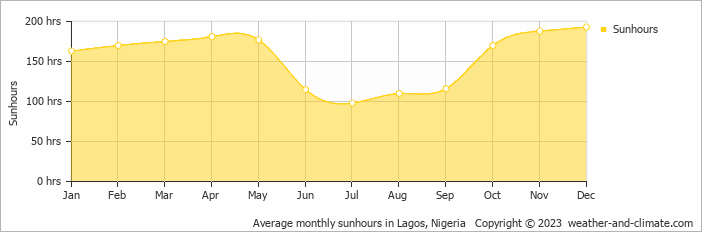
In Lagos, summer days are longer and more sunny, with daily sunshine hours peaking at 6.4 hours in December. As the darker season arrives, the brightness of the sun becomes less. July sees a soft sun for only 3.3 hours per average day.
Visit our detailed sunshine hours page for more information.
Monthly hours of sunshine
Daily hours of sunshine
Humidity in Lagos by Month
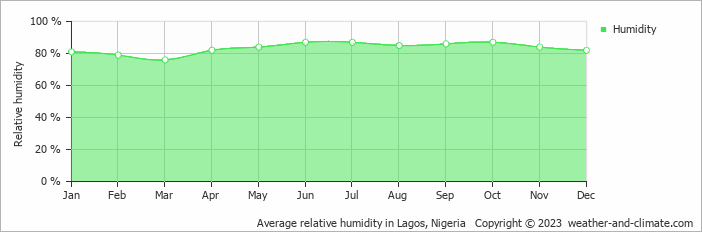
The city experiences its highest humidity in June, reaching 87%. In March, the humidity drops to its lowest level at 76%. What does this mean? Read our detailed page on humidity levels for further details.
Relative humidity over the year
Best Time to Visit Lagos
To make the most of your visit, consider exploring early in the morning or during the pleasant late afternoon hours when the temperature is most comfortable.
Be aware that May, June, July, September and October constitute the rainy season, with significant precipitation. Need help choosing your next travel destination? We offer a specialized tool that matches you with locations based on your weather preferences. Explore destinations that suit your climate preferences.
Frequently asked questions about the climate in Lagos
What is the best time to visit Lagos?
August typically offers the most optimal weather in Lagos. In contrast, May and June tend to have less optimal conditions. Lagos has a distinct rainy season from May to July.
What temperatures can I expect in Lagos?
Daytime highs range from 28°C (82°F) in August to 31°C (88°F) in February. Nighttime lows range from 24°C (75°F) to 27°C (81°F). Temperatures stay relatively stable year-round.
How much rain does Lagos get?
Annual rainfall is around 1729 mm (68 in). June is the wettest month with 313 mm (12 in), while January is the driest with 37 mm (1.5 in).
How sunny is Lagos?
Lagos receives around 1,856 hours of sunshine per year. December is the sunniest month with 193 hours, while July is the cloudiest with just 98 hours.
Lagos 3-Day Forecast
Lagos on the map
Lagos is highlighted — select any city to see its climate.
Popular this month
Where to go in July — average daytime high across popular destinations.
Bucket list
Need travel inspiration? Check out our bucket list articles and be inspired.