
London Weather & Climate: Best Time to Visit
London experiences a temperate maritime climate. This climate type is characterized by a tempered temperature because of the nearby sea water. In summer, the cooler seawater ensures that it is not extremely hot. In winter months, the relatively warm seawater ensures that the risk of extreme cold is much lower.
London has the image always to be wet and gray. But if you look at the whole of the United Kingdom, London is actually one of the most sunny and dry cities in the country. With a quantity of rain that comes out below six hundred millimetres per year, London is drier than for example Rome. With a number of hours of sunshine that averages around fifteen hundred a year, London is not to be called extremely sunny but it is not to bad as well.
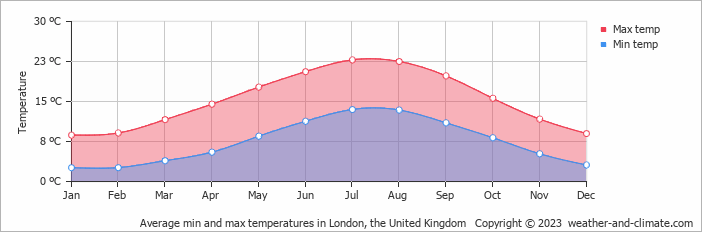
Summers have pleasant temperatures with average high temperatures around 23°C (73°F) and night temperatures of 13°C (55°F).
Winters in London are cold, but the temperature is hardly below freezing. Snow occurs sometimes in winter but rarely settles more than a few millimetres deep.
Springs is a great period to visit London. During the day it is nice and warm, however in the evenings it is still very cool. In autumn months it can occasionally storm. The rainfall is evenly spread throughout the year.
Monthly Temperature in London
Visitors to London can expect significant temperature changes throughout the year. Average maximum daytime temperatures range from a comfortable 23°C (73°F) in July, the warmest time of the year, to a chilly 9°C (48°F) during cooler months like January.
At night, you can expect temperatures ranging from 14°C (57°F) in July to around 3°C (37°F) during January.
Check out our detailed temperature page for more information.
Temperature ranges by month
Rainfall in London
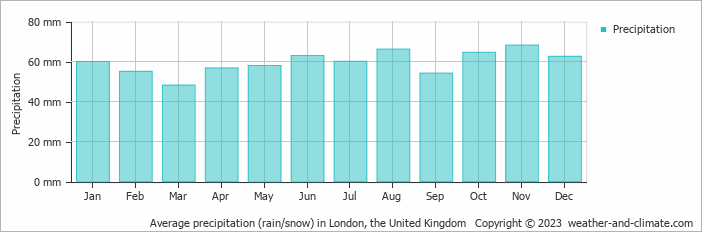
Generally, London experiences moderate precipitation patterns, averaging 716 mm (28 in) yearly. Year-round, London has a balanced climate with minimal variation in precipitation. The difference between the wettest month, November, with 68 mm (2.7 in), and the driest month, March, with 48 mm (1.9 in), is minimal. For more details, please visit our London Precipitation page.
The mean monthly precipitation over the year, including rain, hail, and snow
The average number of days each month with precipitation

Sunshine Hours in London
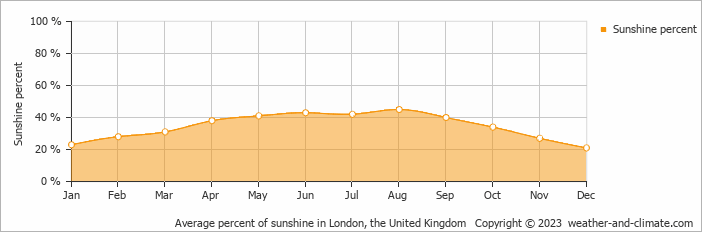
Seasonal changes in sunshine hours are quite dramatic in London. While July receives considerable daily sunshine with up to 7.3 hours, December marks the darkest time of the year, where sunshine is scarce with only 1.8 hours of sunlight per day.
Visit our detailed sunshine hours page for more information.
Monthly hours of sunshine

Daily hours of sunshine
Daily percentage of sunshine
Humidity in London by Month
The relative humidity is high throughout the year in London.
The city experiences its highest humidity in November, reaching 81%. In April, the humidity drops to its lowest level at 64%. What does this mean? Read our detailed page on humidity levels for further details.
Relative humidity over the year

Wind Speed in London
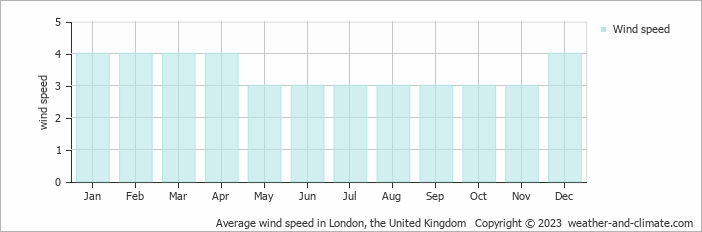
The average wind speed over the year ranges from 3 m/s (6 knots) to 4 m/s (8 knots). It is lower in May, June, July, August, September, October and November and higher in January, February, March, April and December. What does this mean?
The mean monthly wind speed over the year (meters per second)
London 3-Day Forecast
Check the conditions for any month of the year.
Best Time to Visit London
During June, July, August and September, London experiences its most favorable weather, with temperatures between 20°C (68°F) and 23°C (73°F). These mild conditions make it an excellent time for a visit.The weather does bring rainfall during this period, between 54 mm (2.1 in) and 66 mm (2.6 in). Need help choosing your next travel destination? We offer a specialized tool that matches you with locations based on your weather preferences. Explore destinations that suit your climate preferences.