


















 An alternative way to discover Sydney
We have made an overview of the sights in Sydney that you must see if you want to visit Sydney in an alternative way.
This page shows both the average monthly rainfall and the number of rainy days in Werribee, Victoria, Australia. The figures are based on a 30-year period (1990–2020) to provide a reliable average. Let's explore the details to provide you with a complete overview.
Generally, Werribee has a moderate amount of precipitation, averaging 625 mm (25 in) of rainfall annually.
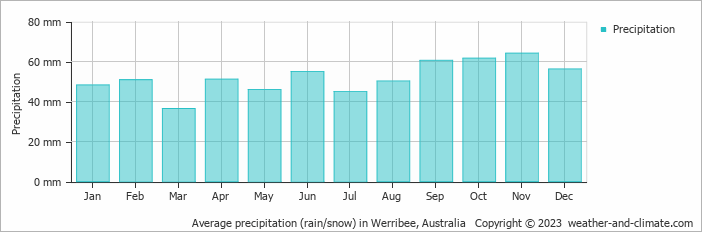
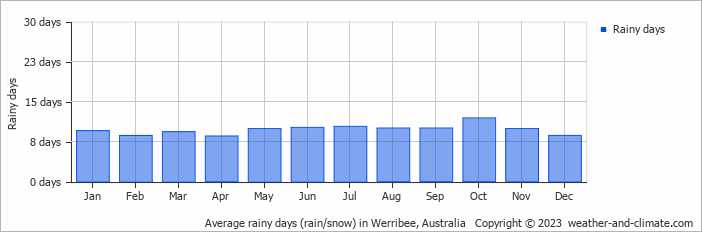
The amount of precipitation varies moderately throughout the year. The wettest month, November, sees around 64 mm (2.5 in) of rainfall, perfect for those who enjoy a bit of rain now and then. The driest month, March, still receives a respectable 36 mm (1.4 in) of rainfall.
November, the wettest month, has a maximum daytime temperature of 21°C (70°F). The city receives 225 hours of sunshine in this period. During the driest month March you can expect a temperature of 23°C (73°F). For more detailed insights into the city's temperatures, visit our Werribee Temperature page.
The map below shows the annual precipitation across Australia. You can also select the different months in case you are interested in a specific month.
Werribee's average annual precipitation is 625 mm (25 in). Let's compare this to some popular worldwide tourist destinations:
Boston, USA, experiences 1238 mm (49 in) of annual precipitation, including significant snowfall during the winter.
Beijing, China, receives 560 mm (22 in) of annual precipitation, concentrated in the summer months.
Perth, Australia, receives 565 mm (22 in) of rainfall annually, mostly during the winter months.
Mumbai, India, experiences a tropical monsoon climate with 1860 mm (73 in) of annual rainfall, with the majority of precipitation happening during the monsoon season from June to September.
Precipitation amounts are measured using specific gauges installed at weather stations, collecting both rain and snow and any other type of precipitation. Rainfall is measured directly in millimeters, while that from snow and ice is obtained by melting it. Automated systems often incorporate heaters to make this easier.
Information from these stations is transmitted via Wi-Fi, satellite, GPS, or telephone connections to central monitoring networks. This information is immediately updated and integrated into weather models and forecasts.
Precipitation has a very strong role in determining the local climate and ecosystem:
For more detailed information about Werribee's weather, including sunshine hours, humidity levels, and temperature data, visit our Werribee Climate page.
Pick a month to see the average temperature, rainfall and sunshine in Werribee - and find the best time to visit.
Temperature Rainfall Sunshine Humidity
See the full Werribee climate overview or explore weather in Australia.
Where to go in September - average daytime high across popular destinations.
Need travel inspiration? Check out our bucket list articles and be inspired.
An alternative way to discover Sydney
We have made an overview of the sights in Sydney that you must see if you want to visit Sydney in an alternative way.
 The most relaxed and alternative area of Australia is called the Byron Shire
The Byron Shire is one of the most pretty areas in the world. Not only in terms on natural beauty, also the relaxed vibe and people make this an area that remains close to your heart.
 Sail the Whitsunday islands
The best travel period to sail the Whitsunday islands is “winter” between June and October, with pleasant temperatures around 23 degrees Celsius (74 Fahrenheit).
 The best dive spots in Australia
Explore Australia's best dive spots: from the Great Barrier Reef to HMAS Perth. Discover vibrant corals, marine life, and historic wrecks.