
















 The Li River: A Journey Through China’s Most Breathtaking Landscape
Explore the Li River, China's breathtaking landscape with majestic mountains, serene waters, and picturesque views. A must-see for every traveler.
This page shows both the average monthly rainfall and the number of rainy days in Dali, Yunnan, China. These values are calculated using 30 years of data (1990–2020) to ensure accuracy. Now, let's break down all the details for a clearer picture.
Dali experiences significant rainfall throughout the year, averaging 1317 mm (52 in) of precipitation annually. However, this abundant rainfall is not evenly distributed, with a distinct dry and rainy season during certain months. You can clearly see this in our monthly precipitation graphs below.
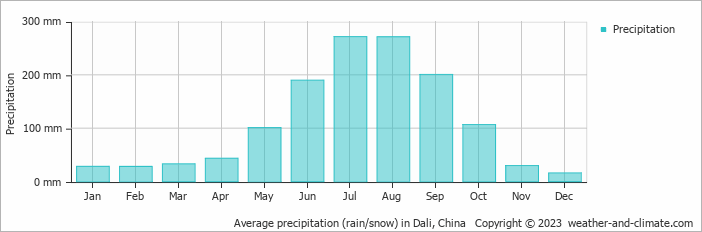
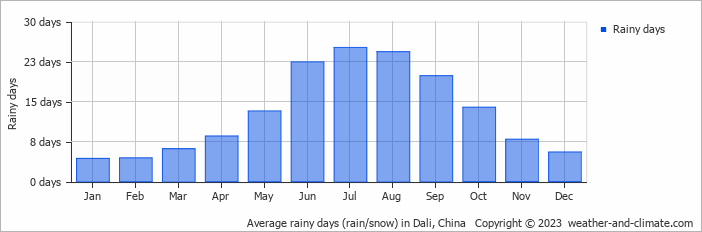
Dali can be quite wet during July, receiving approximately 271 mm (11 in) of precipitation over 25 rainy days.
In contrast December, experiences much drier conditions, with 16 mm (0.6 in) of rainfall, spread across 6 rainy days.
July, the wettest month, has a maximum daytime temperature of 25°C (77°F). During the driest month December you can expect a temperature of 17°C (63°F). For more detailed insights into the city's temperatures, visit our Dali Temperature page.
Average daily rainfall for each day of the month based on long-term records. 50-year average (1976-2025)
Browse day-by-day precipitation records for Dali spanning 51 years. Select any month and year to see actual rainfall and snowfall recorded on each day.
The map below shows the annual precipitation across China. You can also select the different months in case you are interested in a specific month.
Dali's average annual precipitation is 1317 mm (52 in). Let's compare this to some popular worldwide tourist destinations:
Boston, USA, experiences 1238 mm (49 in) of annual precipitation, including significant snowfall during the winter.
Beijing, China, receives 560 mm (22 in) of annual precipitation, concentrated in the summer months.
Melbourne, Australia, has 690 mm (27 in) of rainfall annually, spread fairly evenly throughout the year.
Kuala Lumpur, Malaysia, receives 2529 mm (100 in) of annual rainfall, characteristic of its equatorial tropical rainforest climate, with consistent rainfall throughout the year and peak months during March and November.
Precipitation amounts are measured using specific gauges installed at weather stations, collecting both rain and snow and any other type of precipitation. Rainfall is measured directly in millimeters, while that from snow and ice is obtained by melting it. Automated systems often incorporate heaters to make this easier.
Information from these stations is transmitted via Wi-Fi, satellite, GPS, or telephone connections to central monitoring networks. This information is immediately updated and integrated into weather models and forecasts.
Climate change is affecting precipitation patterns worldwide, including Dali:
For more detailed information about Dali's weather, including sunshine hours, humidity levels, and temperature data, visit our Dali Climate page.
Pick a month to see the average temperature, rainfall and sunshine in Dali - and find the best time to visit.
Temperature Rainfall Humidity
See the full Dali climate overview or explore weather in China.
Where to go in October - average daytime high across popular destinations.
Guangzhou 30°C (86°F) Shenzhen29°C (84°F) Hangzhou25°C (77°F) Shanghai24°C (75°F) Chengdu
 22°C (72°F) Xi'an
 21°C (70°F) Beijing
 21°C (70°F) Qingdao21°C (70°F)
 Need travel inspiration? Check out our bucket list articles and be inspired.
The Li River: A Journey Through China’s Most Breathtaking Landscape
Explore the Li River, China's breathtaking landscape with majestic mountains, serene waters, and picturesque views. A must-see for every traveler.
 Go to China's Zhangjiajie National Park with the highest, the fastest, largest-loaded outdoor elevator in the world
You won't find this unique landscape anywhere else in the world. Thousands of floating mountains overgrown with trees at the top dominate this fairy tale landscape.
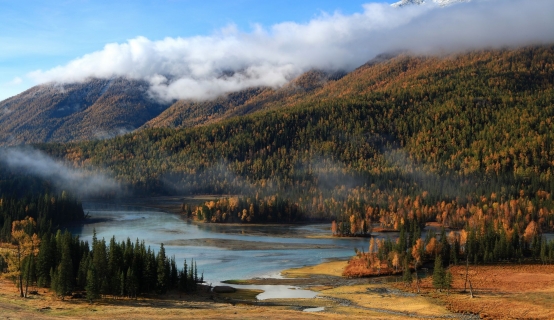 Go to Xinjiang in China
In Xinjiang you get to see a mix of East and Central Asia. An experience that you might want to add to your bucket list. You can travel through the province as if you are following an ancient silk route.
 Mount Kailash
The best time for a Kailash tour/trekking is from mid-May to mid-October when the temperature is most pleasant. It is warm, dry and sunny in that period.