Medellín Monthly Rainfall & Precipitation
This page shows both the average monthly rainfall and the number of rainy days in Medellín, Extremadura, Spain. The figures are based on a 30-year period (1990–2020) to provide a reliable average. Let's now guide you through the details for a complete overview.
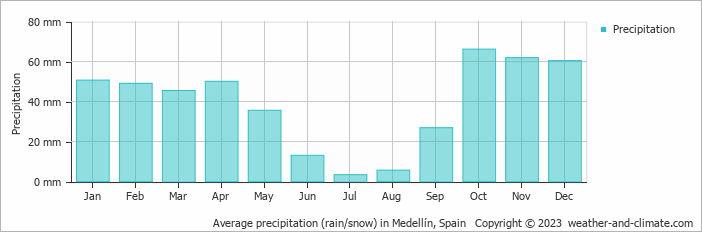
Medellín typically sees modest rainfall throughout the year, with an average annual precipitation of 467 mm (18 in). The city experiences a distinct dry season during certain months, as illustrated in the graph below.
Monthly Precipitation Levels
The average number of days each month with precipitation (> 0.2 mm (0.01 in))
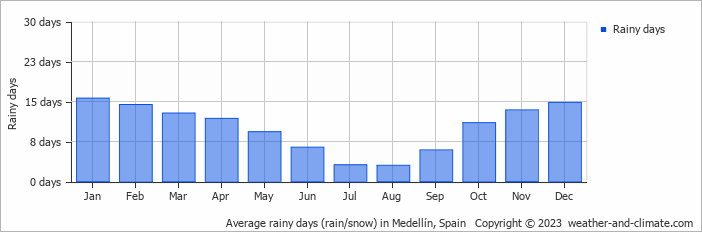
Medellín can be quite wet during October, receiving approximately 66 mm (2.6 in) of precipitation over 11 rainy days.
In contrast July, experiences much drier conditions, with 3.3 mm (0.1 in) of rainfall, spread across 3 rainy days.
October, the wettest month, has a maximum daytime temperature of 24°C (75°F). The city receives 205 hours of sunshine in this period. During the driest month July you can expect a temperature of 36°C (97°F). For more detailed insights into the city's temperatures, visit our Medellín Temperature page.
Annual Rainfall in Spain: City Comparison
The map below shows the annual precipitation across Spain. You can also select the different months in case you are interested in a specific month.
 heavy rainfall
 high
high
 moderate
 low
low
 almost none
Medellín vs World: Rainfall Compared
Medellín's average annual precipitation is 467 mm (18 in). Let's compare this to some popular worldwide tourist destinations:
The climate in San Francisco, USA, is influenced by coastal weather, with 469 mm (18 in) of rainfall mostly during the winter months.
In Seoul, South Korea, the average annual precipitation is 1237 mm (49 in), with most rain falling during the summer monsoon season.
Perth, Australia, receives 565 mm (22 in) of rainfall annually, mostly during the winter months.
Kuala Lumpur, Malaysia, receives 2529 mm (100 in) of annual rainfall, characteristic of its equatorial tropical rainforest climate, with consistent rainfall throughout the year and peak months during March and November.
Precipitation amounts are measured using specific gauges installed at weather stations, collecting both rain and snow and any other type of precipitation. Rainfall is measured directly in millimeters, while that from snow and ice is obtained by melting it. Automated systems often incorporate heaters to make this easier.
Information from these stations is transmitted via Wi-Fi, satellite, GPS, or telephone connections to central monitoring networks. This information is immediately updated and integrated into weather models and forecasts.
Precipitation has a very strong role in determining the local climate and ecosystem:
- Changing Rainfall Patterns: Global warming causes drastic changes in the patterns of rainfall. Some areas have been experiencing increased frequency and intensity of rainfall, while other areas experience longer dry spells or even droughts.
- Local Impacts: Many regions are experiencing heavier rainfall in the winter months and drier, hotter summers. This affects agriculture, water resources, and ecosystems.
- The U.S. has a significant number of thunderstorms every year, with over 14.6 million taking place across the world annually.
- Approximately 70% of lightning bolts strike land rather than oceans.
- A storm named John was the longest-lasting Pacific tropical storm, continuing for 31 days. As it crossed the dateline twice, it changed status from a hurricane to a typhoon and back to a hurricane.
For more detailed information about Medellín's weather, including sunshine hours, humidity levels, and temperature data, visit our Medellín Climate page.