Yellowstone National Park Weather & Climate: Best Time to Visit

Average temperatures, rainfall, sunshine and the best time to visit Yellowstone National Park.

Climate overview of Yellowstone National Park

Do you want to visit Yellowstone National Park with pleasant temperatures? Then the months of June to September are the best time to visit Yellowstone National Park. Although a (nighttime) snow shower cannot be completely ruled out at the beginning of June, in these months you are most treated to quite a large number of hours of sunshine and a daytime temperature of about 20°C (68°F).

Especially in July and August, when the weather and climate in Yellowstone is most pleasant, many people travel to Yellowstone. The chance of park closures is then the smallest. It can be a bit busy during this period so it is recommended to book a place to stay in advance.

Yellowstone National Park Weather by Month

Pick a month to see the average temperature, rainfall and sunshine in Yellowstone National Park — and find the best time to visit.

Monthly Temperature in Yellowstone National Park

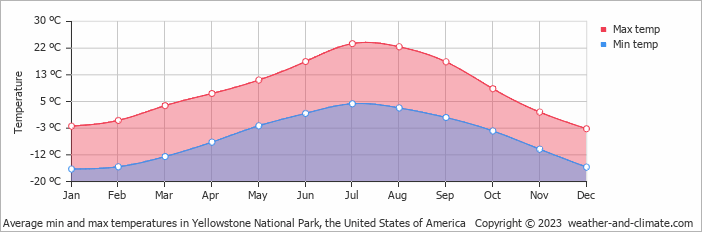
Depending on the time of the year, temperatures range from comfortable to very cold in Yellowstone National Park. Typically, average maximum daytime temperatures range from a comfortable 23°C (73°F) in July to a very cold -4°C (25°F) in the coolest month, January.

Nights vary from 4°C (39°F) in July to around -16°C (3°F) during the colder months.

Check out our detailed temperature page for more information.

Temperature ranges by month

Rainfall in Yellowstone National Park

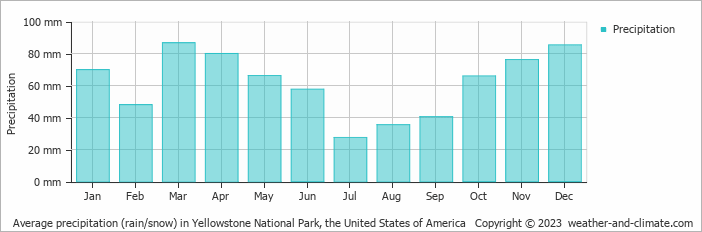
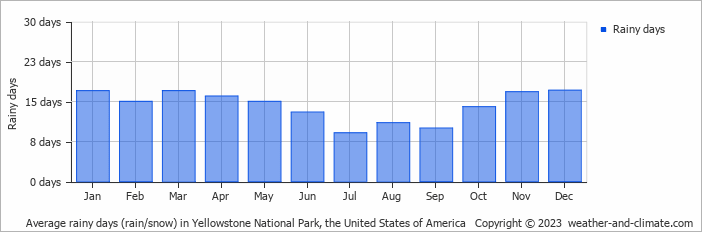
Generally, Yellowstone National Park has a moderate amount of precipitation, averaging 738 mm (29 in) of rain/snowfall annually. The climate in Yellowstone National Park shows significant variation throughout the year. Expect moderate snowfall in March, the wettest month, with an average of 87 mm (3.4 in) of precipitation over 17 snowy days.

In contrast, the driest month July offers drier and sunnier days, with around 27 mm (1.1 in) of rainfall over 9 rainy days. For more details, please visit our Yellowstone National Park Precipitation page.

The mean monthly precipitation over the year, including rain, hail, and snow

Best Time to Visit Yellowstone National Park

During the months of June, July, August and September, Yellowstone National Park enjoys pleasant weather with average temperatures ranging from 17°C (63°F) to 23°C (74°F). These months are perfect for sightseeing and exploring.

Rainfall during this time ranges from 27 mm (1.1 in) in July to 58 mm (2.3 in) in June. This means you can expect a mix of sunny days and occasional showers.

Planning your next adventure but unsure where to go? Our climate tool suggests perfect locations tailored to your preferred weather conditions. Discover your ideal travel destination with our weather planner.

Frequently asked questions about the climate in Yellowstone National Park

What is the best time to visit Yellowstone National Park?

July and August typically offer the most optimal weather in Yellowstone National Park. In contrast, January, February, March, April, October, November and December tend to have less optimal conditions. Yellowstone National Park has a distinct dry season from July to August.

What temperatures can I expect in Yellowstone National Park?

Daytime highs range from -4°C (25°F) in January to 23°C (73°F) in July. Nighttime lows range from -16°C (3°F) to 4°C (39°F). Temperatures vary considerably through the year.

How much rain does Yellowstone National Park get?

Annual rainfall is around 738 mm (29 in). March is the wettest month with 87 mm (3.4 in), while July is the driest with 27 mm (1.1 in). In the coldest months, precipitation may fall as snow.

Yellowstone National Park 3-Day Forecast

Yellowstone National Park 3-Day Forecast

Yellowstone National Park on the map

Yellowstone National Park is highlighted — select any city to see its climate.

Popular this month

Where to go in July — average daytime high across popular destinations.

Bucket list

Need travel inspiration? Check out our bucket list articles and be inspired.