
Gisborne Weather & Climate: Best Time to Visit
Gisborne, in the Gisborne region of New Zealand, experiences moderate temperature changes over the year, with warm summers and mild winters. Rainfall is fairly balanced throughout the seasons, without extreme wet or dry periods. The climate supports a strong focus on vineyards, surfing, and outdoor markets, with many locals and tourists spending time outside year-round. Now, let’s break down all the climate details for a clearer picture.
Monthly Temperature in Gisborne
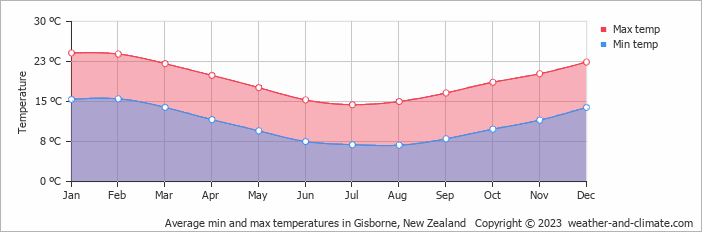
The weather in Gisborne changes moderately throughout the year, offering enough variation to appreciate each season. Average maximum daytime temperatures range from a comfortable 24°C (75°F) in January, the warmest time of the year, to a moderate 14°C (57°F) during cooler months like August.
At night, you can expect temperatures ranging from 16°C (61°F) in January to around 7°C (45°F) during August.
Check out our detailed temperature page for more information.
Temperature ranges by month
Rainfall in Gisborne
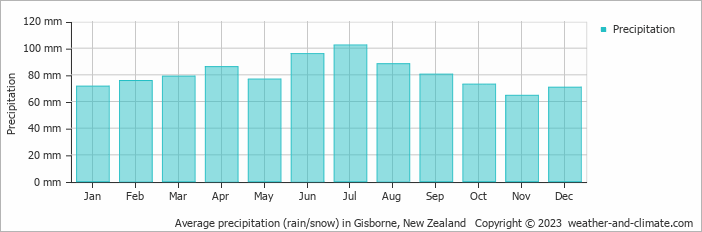
Generally, Gisborne has a moderate amount of precipitation, averaging 963 mm (38 in) of rainfall annually. Year-round, Gisborne has a balanced climate with minimal variation in precipitation. The difference between the wettest month, July, with 102 mm (4 in), and the driest month, November, with 65 mm (2.6 in), is minimal. For more details, please visit our Gisborne Precipitation page.
The mean monthly precipitation over the year, including rain, hail, and snow
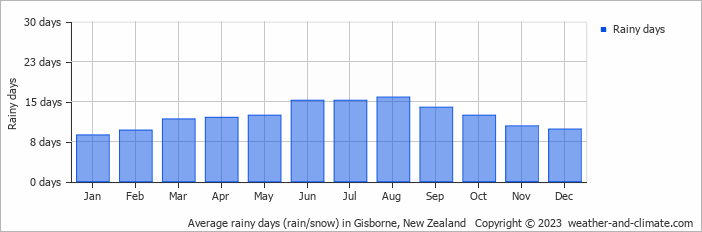
The average number of days each month with precipitation
Sunshine Hours in Gisborne
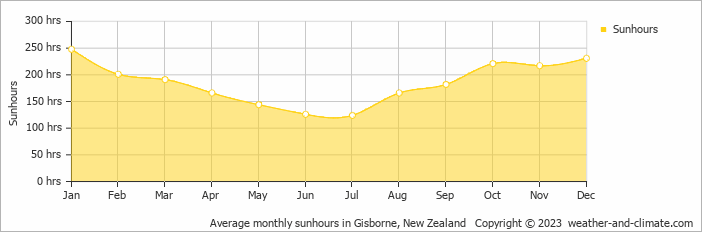
Seasonal changes in sunshine hours are quite dramatic in Gisborne. While January receives considerable daily sunshine with up to 8.3 hours, July marks the darkest time of the year, where sunshine is scarce with only 4.1 hours of sunlight per day.
Visit our detailed sunshine hours page for more information.
Monthly hours of sunshine
Daily hours of sunshine
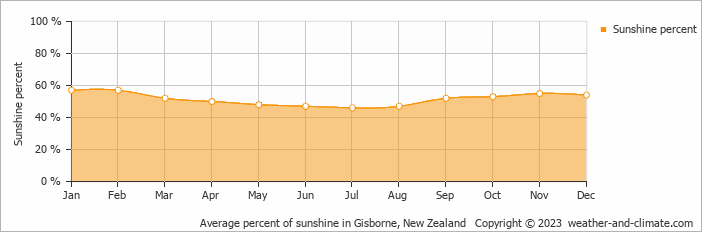
Daily percentage of sunshine
Water Temperature in Gisborne
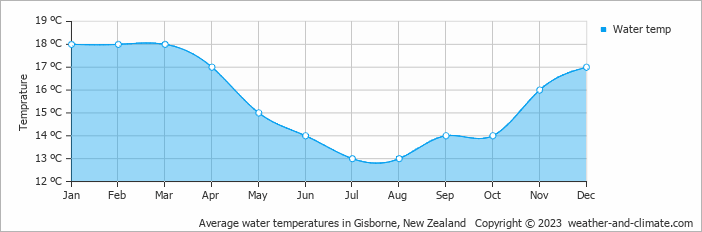
The mean water temperature over the year ranges from 13°C (55°F) in July to 18°C (64°F) in January.
Water temperature over the year
Humidity in Gisborne by Month
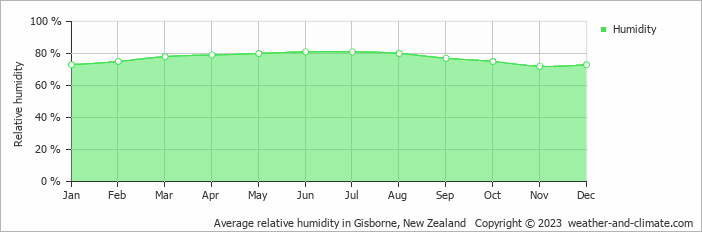
The relative humidity is high throughout the year in Gisborne.
The city experiences its highest humidity in June, reaching 81%. In November, the humidity drops to its lowest level at 72%. What does this mean? Read our detailed page on humidity levels for further details.
Relative humidity over the year
Wind Speed in Gisborne
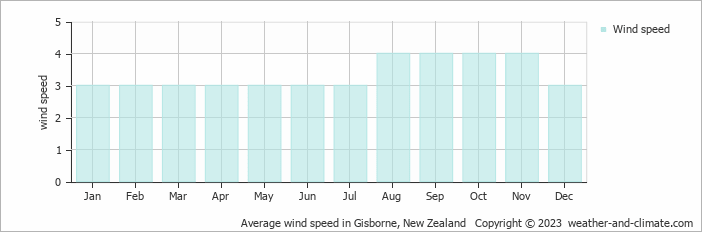
The mean wind speed varies between 3 m/s (6 knots) and 4 m/s (8 knots) throughout the year. It is lowest in January, February, March, April, May, June, July and December and highest during August, September, October and November. What does this mean?
The mean monthly wind speed over the year (meters per second)
Gisborne 3-Day Forecast
Check the conditions for any month of the year.
Best Time to Visit Gisborne
During the months of January, February, March, April, October, November and December, Gisborne enjoys pleasant weather with average temperatures ranging from 19°C (65°F) to 24°C (75°F). These months are perfect for sightseeing and exploring.Rainfall during this time ranges from 65 mm (2.6 in) in November to 86 mm (3.4 in) in April. This means you can expect a mix of sunny days and occasional showers. Looking for inspiration on where to travel this year? We have a tool that recommends destinations based on your ideal conditions. Find out where to go with our weather planner.