Seattle (WA) Sunshine Hours by Month
Sunshine plays a big role in understanding the climate of a city. This page shows the total number of hours of direct sunlight per month and the average hours per day in Seattle, Washington State, United States of America. The numbers reflect climate data gathered over a 30-year period, from 1990 to 2020.
Monthly hours of sunshine
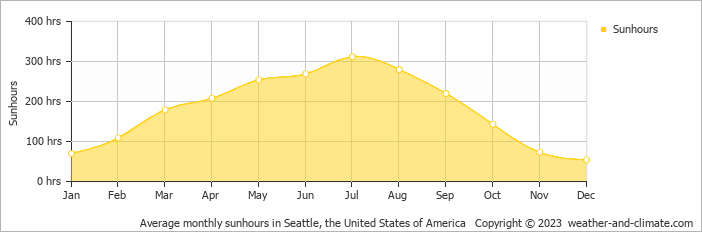
Sunshine in Seattle varies greatly throughout the year. The sunniest month, July, reaches an impressive 312 hours, while December, the darkest month, offers only 54 hours. The total annual amount of sun is 2171 hours.
Daily hours of sunshine
In Seattle, summer days are longer and more sunny, with daily sunshine hours peaking at 10.4 hours in July. As the darker season arrives, the brightness of the sun becomes less. December sees a soft sun for only 1.8 hours per day.
Average percent of sunshine
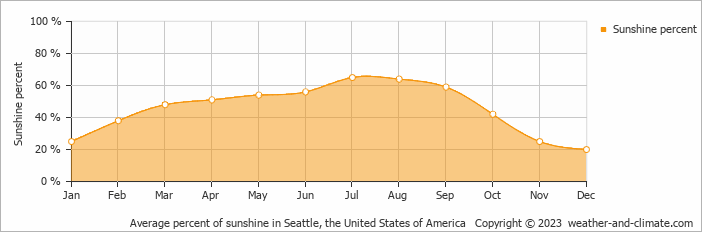
On average the sun shines 65% of the time during the day in July, the highest percentage of any month. December has the lowest percentage at 20%.
Seattle vs Major Cities: Sunshine Compared
Seattle enjoys an average of 2171 hours of sunshine annually. Let’s compare this with some popular tourist destinations:
In Lisbon, Portugal, there are approximately 2801 hours of sunshine annually, highlighting its warm and sunny Mediterranean climate.
In contrast, Reykjavík, Iceland, receives only about 1330 hours of sunshine per year, known for its frequently overcast and rainy skies.
Boston, USA, enjoys 2629 hours of sunshine annually, with distinct seasons and many bright, sunny days.
In Brisbane, Australia, the annual sunshine averages 2999 hours, making it one of Australia’s sunniest cities.
Related Climate Data for Seattle
November, Seattle’s wettest month, receives 14 mm (0.6 in) of rainfall and has a maximum daytime temperature of 11°C (52°F). During the driest month July you can expect a temperature of 25°C (77°F).
For more detailed insights into the city’s temperatures, check out our Temperature page. To explore more about precipitation patterns, visit our Seattle Precipitation page.